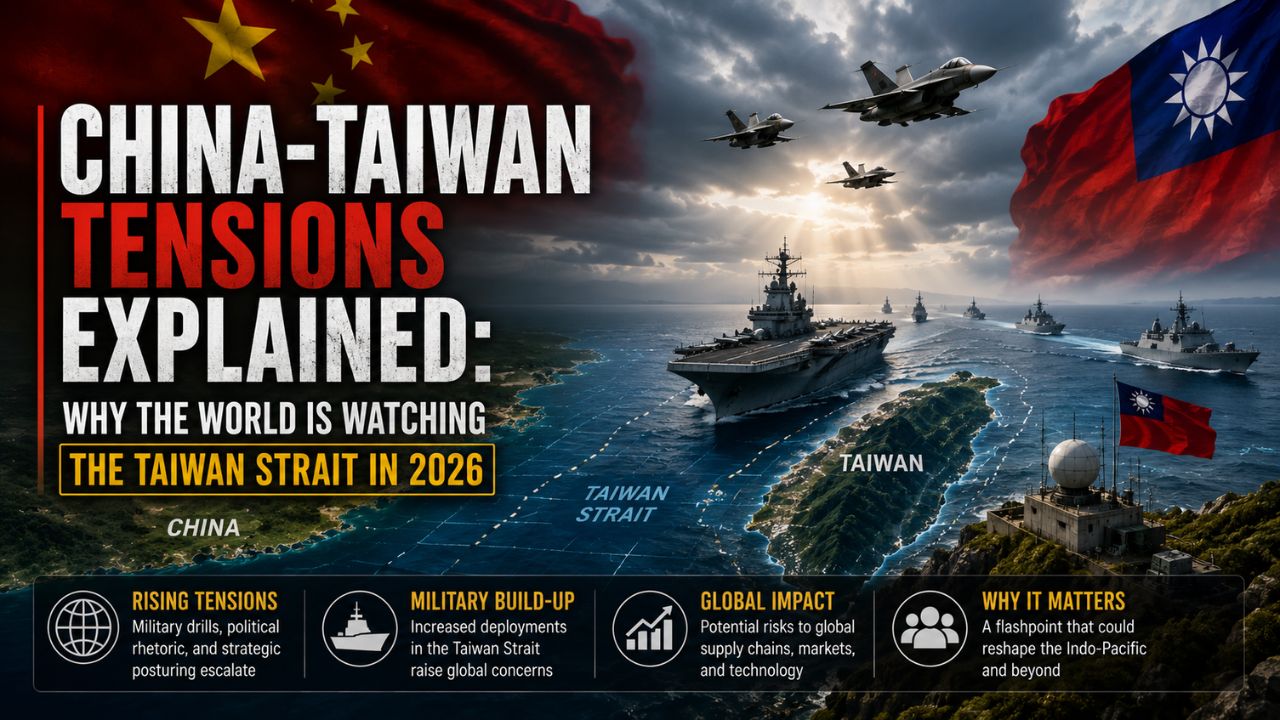
China and Taiwan haven’t fired a shot at each other, but Chinese ships now circle Taiwanese islands for 24 hours at a time, and 2026 keeps getting called a “crucial year.” Here’s what’s actually happening, why it matters far beyond Asia, and how it could pull in the US, Japan, and the global economy.
What is happening?
China is steadily increasing pressure on Taiwan without launching an outright attack. Rather than invade, Beijing is using what analysts call a coercion toolkit: constant military activity, coast guard patrols, and political pressure designed to wear Taiwan down over time while avoiding the kind of single dramatic event that would force the world to respond.
The activity has become routine and is escalating in small but deliberate steps. According to the Institute for the Study of War and AEI, on June 20,26 a Chinese Coast Guard vessel circled Taiwan’s Pratas Island twice while patrolling inside Taiwan’s restricted waters for over 24 hours, and for the first time coordinated that patrol with a Chinese research vessel sailing along the edge of the same waters. Days later, on June 11, two Chinese government ships entered the restricted waters of Itu Aba, the only island in the disputed Spratly archipelago that Taiwan administers, which Taiwan’s Coast Guard condemned as a first-of-its-kind violation of its sovereignty.
Each of these moves is calibrated to look small enough on its own to avoid triggering a crisis, while collectively normalizing a Chinese presence in waters Taiwan controls. The pattern matters more than any single incident: what looks routine after the tenth occurrence was unthinkable before the first.
Why did this happen?
The core dispute is decades old. China claims Taiwan as part of its territory, while Taiwan functions as a self-governing democracy with its own government, military, currency, and elections. The two have been governed separately since 1949, but Beijing has never renounced the goal of bringing the island under its control.
As the Australian Strategic Policy Institute explains, Beijing has relied on a broad toolkit of coercion to wear Taiwan down with diplomatic isolation, information operations, economic pressure, and sustained military activity around the island, all designed to shape the strategic environment while preserving flexibility for Beijing rather than committing to a single risky course of action.
But most analysts agree an actual invasion in 2026 is unlikely, and the reasons are revealing. The same ASPI analysis notes that China is entering 2026 with serious economic headwinds slowing growth, weak domestic consumption, a fragile property sector, high youth unemployment, and mounting local government debt. Because the Communist Party’s legitimacy has historically rested on improving living standards, and even a limited war over Taiwan could cost China trillions of dollars, Xi has generally prioritized regime stability over risky adventurism. Escalating over Taiwan right now would also undermine Beijing’s parallel efforts to stabilize trade, technology access, and diplomatic channels with Washington, the same truce dynamics currently shaping the US-China trade war.
In other words, the pressure campaign isn’t a prelude to imminent invasion so much as a long game: keep Taiwan isolated, divided, and uncertain, and keep every option open.
Who is affected and how?
Taiwan sits at the center, but the consequences reach far beyond the island. Its own politics are part of the story. As Al Jazeera reported, President William Lai has called for a $40 billion increase in Taiwan’s military spending, but the proposal is stalled in the legislature, where the opposition holds a majority. Lai himself has said 2026 will be a crucial year, warning that Taiwan must “make plans for the worst, but hope for the best.” According to the Institute for the Study of War, that internal gridlock has real consequences: Taiwan’s opposition parties have significantly delayed the 2026 general budget, which analysts warn could weaken Taiwan’s defense readiness and damage international confidence in its willingness to defend itself.
The United States is the other major player, and its position is deliberately ambiguous. Al Jazeera notes that Washington recently approved an $11 billion arms package for Taiwan and has urged Beijing to exercise restraint, but US policy has been marked by decades of strategic ambiguity and includes no firm guarantee of military support if China attacks. That ambiguity is intentional: it’s meant to deter China from invading while also discouraging Taiwan from formally declaring independence. The friction is escalating on the economic front too. The June 18 ISW update reports that the US Department of Defense expanded its list of companies it believes are tied to China’s military to include tech giants like Alibaba and Tencent, with the Defense Department set to be barred from contracting with them from June 30, 2026.
Then there’s the reason the entire world has a stake in this standoff: chips. Taiwan produces the overwhelming majority of the world’s most advanced semiconductors, the processors inside phones, cars, data centers, AI systems, and weapons. According to the US government’s trade office, Taiwan accounts for over 60% of global foundry revenue and more than 90% of leading-edge chip manufacturing. A single company, TSMC, sits at the heart of it. As 24/7 Wall St. reports, TSMC now controls roughly 72% of the global foundry market and manufactures advanced chips for Nvidia, AMD, Apple, and Broadcom, many running near full capacity.
That concentration is exactly why a disruption in the Taiwan Strait, even one short of war, would ripple through global supply chains and prices almost immediately. The vulnerability isn’t only military. As Supply Chain Digital reports, TSMC is pouring $165 billion into new fabrication plants in Arizona specifically to diversify production away from Taiwan, but the second and third of those plants won’t begin production until 2027 and the end of the decade. Until then, the world’s most critical technology remains concentrated on an island under steady pressure from its much larger neighbor.
What happens next?
Three realistic scenarios stand out, and they aren’t mutually exclusive.
Continued coercion short of war. This is the most likely path. Beijing keeps using patrols, drills, and economic pressure to wear Taiwan down while avoiding the enormous cost and risk of an actual invasion. The goal is to make Taiwan’s position feel increasingly hopeless without ever firing a shot.
Gradual normalization of Chinese presence. Each 24-hour patrol and each “first-of-its-kind” incursion that goes unchallenged makes the next one look routine. Over time, this slowly erodes Taiwan’s effective control of its own waters and airspace without a single battle, a strategy sometimes described as boiling the frog.
A miscalculation that escalates. With ships and aircraft from both sides operating in close quarters almost daily, the real near-term danger isn’t necessarily a planned war. It’s an accident, collision, or standoff that spirals before either side can find an exit, dragging in the US and Japan, whether they intended to be involved or not.
Key takeaway
- China is pressuring Taiwan through constant patrols and incursions rather than a direct attack, and most analysts consider a full invasion in 2026 unlikely given China’s serious economic problems.
- Taiwan’s own divided legislature has stalled key defense budgets, raising real questions about its readiness even as external pressure grows.s
- Because Taiwan makes more than 90% of the world’s leading-edge chips and TSMC alone controls about 72% of the foundry market, even a non-violent disruption in the strait would hit global supply chains and prices fast, and US efforts to diversify won’t fully pay off until 2027 at the earliest