
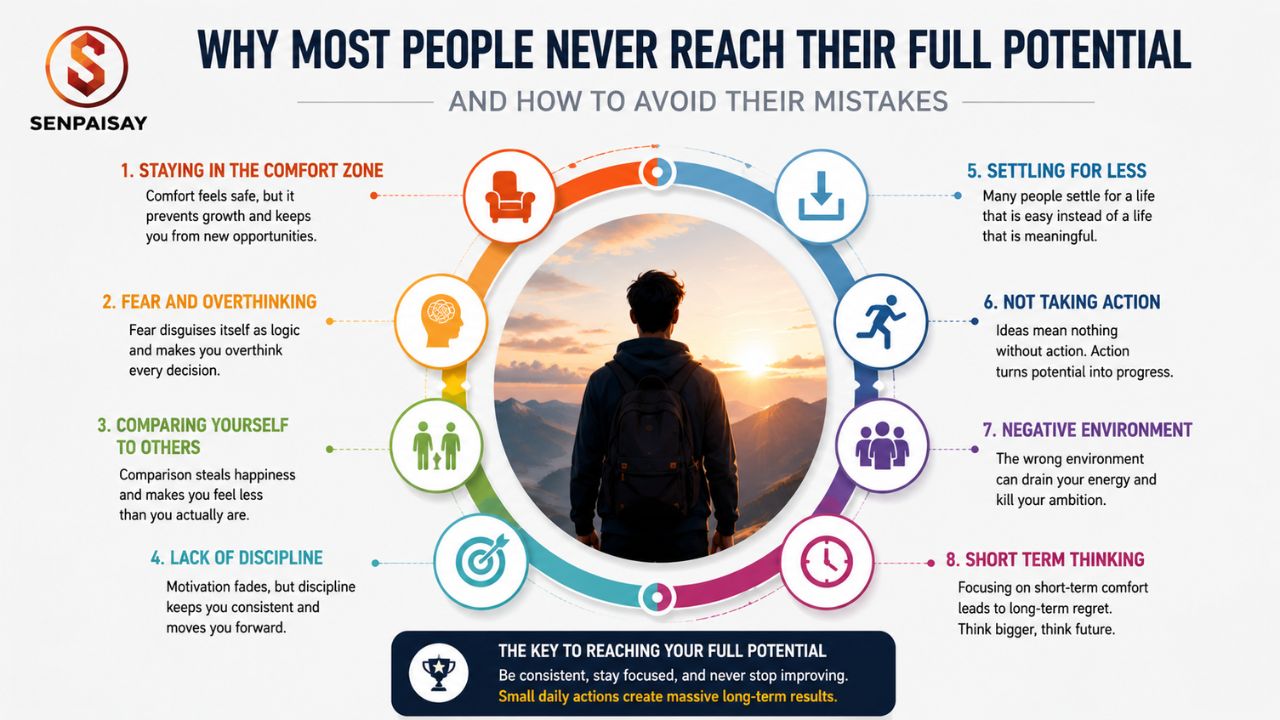
Every person enters the world with potential. Some have the potential to build businesses, create meaningful work, lead others, or develop skills that can completely transform their lives. Yet if you look around, you will notice something surprising. Most people never come close to discovering what they are truly capable of becoming. They settle for less than they once imagined, not because they lack ability, but because they slowly stop pursuing growth.
The tragedy is that unrealized potential rarely announces itself dramatically. Most people do not wake up one morning and decide to abandon their ambitions. Instead, it happens gradually. Small compromises accumulate over time. Goals become less important than comfort. Dreams are postponed until the “right time,” and eventually the right time never arrives. Years pass, and the person who once imagined a different future begins accepting a life that feels safe but unfulfilling.
What makes this even more unfortunate is that many people never realize how much more they were capable of achieving. They assume their limitations were real when, in many cases, those limitations existed only in their minds. Understanding why this happens is the first step toward ensuring it does not happen to you.
Why Comfort Becomes the Enemy of Growth
Comfort is one of the most attractive things in life. It provides security, predictability, and relief from uncertainty. There is nothing wrong with enjoying comfort, but problems arise when comfort becomes more important than growth. The moment comfort becomes the primary goal, personal development often begins to slow.
Human beings are naturally drawn toward familiar environments. We enjoy routines because they require less effort and less risk. The challenge is that growth rarely happens inside familiar territory. Learning a new skill feels uncomfortable because it exposes weaknesses. Starting a business feels uncomfortable because there is no guarantee of success. Speaking in front of people feels uncomfortable because there is a possibility of embarrassment.
Most people spend their lives avoiding these uncomfortable experiences. As a result, they remain exactly where they are. The individuals who reach their potential are not necessarily more talented than everyone else. They are often the people who become willing to tolerate temporary discomfort in exchange for long-term growth.
Every meaningful achievement requires stepping beyond what feels familiar. Growth begins the moment comfort stops controlling your decisions.
The Fear That Disguises Itself as Logic
One of the most dangerous obstacles to personal growth is fear, particularly when it disguises itself as rational thinking. Fear rarely appears as an obvious warning. Instead, it often presents itself as caution, preparation, or practicality. It convinces people that they need more time before taking action. It tells them they should wait until they have more experience, more resources, or greater confidence.
At first, this advice seems reasonable. Preparation is important. Planning has value. The problem arises when preparation becomes an excuse for inaction. Many people spend years getting ready for opportunities they never pursue. They continue gathering information while avoiding the very experiences that would help them grow.
The reality is that nobody feels completely ready when they begin something important. Entrepreneurs do not feel ready when they launch their first business. Writers do not feel ready when they publish their first article. Athletes do not feel ready when they enter their first competition. Confidence is often developed through action rather than preparation.
Those who reach their potential understand that uncertainty is part of progress. They learn to move forward despite fear instead of waiting for fear to disappear.
The Comparison Trap That Holds People Back
Modern technology has created unprecedented opportunities, but it has also made comparison a daily habit for millions of people. Every time someone opens social media, they are exposed to carefully selected highlights from other people’s lives. Success stories, achievements, luxury lifestyles, and major milestones appear constantly, creating the illusion that everyone else is moving faster.
The problem is that comparison distorts reality. People compare their own behind-the-scenes struggles to someone else’s public victories. They see the finished product without seeing the years of effort that made it possible. They see the outcome without seeing the setbacks, sacrifices, and failures that came before it.
This creates discouragement. Progress begins to feel slow because someone else appears further ahead. Potential starts to feel limited because another person seems more successful.
The truth is that every journey unfolds at its own pace. Some people achieve success early, while others require more time. Neither path is inherently better. What matters is whether you are improving compared to who you were yesterday. Personal growth is not a competition against others. It is a commitment to becoming a better version of yourself.
Why Discipline Matters More Than Motivation
Many people spend years searching for motivation, believing it is the key to success. They read inspirational books, watch motivational videos, and wait for the perfect mindset to arrive. While motivation can certainly be useful, it is not reliable enough to build an extraordinary life.
Motivation changes constantly. Some days you feel inspired and energetic. Other days you feel tired, distracted, or discouraged. If your progress depends entirely on motivation, your results will fluctuate with your emotions.
Discipline works differently. Discipline allows you to continue taking action even when motivation is absent. It creates consistency, and consistency is what ultimately produces results. Successful people understand this distinction. They do not rely on feeling motivated every day. Instead, they build routines and habits that keep them moving forward regardless of how they feel.
Over time, discipline becomes a competitive advantage. While others stop whenever motivation fades, disciplined individuals continue making progress. Those small daily efforts eventually compound into significant achievements.
The Power of Small Daily Improvements
One reason many people fail to reach their potential is that they underestimate the value of small actions. They become obsessed with dramatic breakthroughs and life-changing moments while overlooking the importance of consistent improvement.
Real growth is usually far less dramatic than people expect. It often looks like reading a few pages each day, practicing a skill for an hour, writing regularly, exercising consistently, or making one small improvement at a time. None of these actions seem impressive individually. However, when repeated over months and years, they produce remarkable results.
The most successful people understand the power of accumulation. They focus less on achieving immediate perfection and more on making steady progress. They trust that small actions performed consistently will eventually create outcomes that seem impossible to others.
Potential is rarely unlocked through a single breakthrough. More often, it is unlocked through thousands of small decisions made correctly over time.
The Influence of Your Environment
People often underestimate how much their environment influences their behavior. The individuals you spend time with, the information you consume, and the conversations you participate in all shape your beliefs about what is possible.
A negative environment can quietly limit ambition. If you constantly hear people complaining, making excuses, or dismissing opportunities, those attitudes begin to affect your thinking. On the other hand, spending time around growth-oriented individuals can expand your perspective and encourage greater action.
This does not mean you must remove everyone from your life who thinks differently. It simply means becoming intentional about the influences you allow to dominate your attention. The environment surrounding you can either accelerate your growth or quietly hold it back.
Successful people recognize this reality and make conscious decisions about the people, habits, and information they allow into their lives.
The Difference Between Interest and Commitment
Many people are interested in success, but relatively few are committed to it. Interest exists when conditions are favorable. Commitment remains when conditions become difficult.
Someone interested in fitness exercises when they feel motivated. Someone committed to fitness continues training even when they would rather stay home. Someone interested in building a business works when progress feels exciting. Someone committed continues during setbacks and uncertainty.
This distinction is important because reaching your potential requires long-term effort. There will be periods when enthusiasm fades, results are slow, and challenges seem overwhelming. During those moments, commitment becomes more important than excitement.
The people who achieve extraordinary things are often not the most naturally gifted. They are the individuals who continue showing up long after others have stopped.