
Having big dreams can feel overwhelming when the people around you doubt your potential or question your goals.
Learning how to stay motivated during those moments is essential if you want to turn your vision into reality
There comes a point in many people’s lives when they realize that the dream they care about most is a dream they must carry alone. It might be a business idea, a creative project, a career change, or a personal goal that feels bigger than anything they have attempted before. In their mind, the vision is clear. They can see the possibilities, the opportunities, and the future they want to build. Yet when they share that vision with others, the response is often disappointing. Instead of excitement, they receive skepticism. Instead of encouragement, they hear warnings about why it may not work.
This experience can feel incredibly isolating because human beings naturally seek support from the people around them. We want friends to celebrate our ambitions and family members to believe in our potential. When that support is missing, self-doubt can begin to grow. Questions that never existed before start appearing in our minds. We wonder if we are being unrealistic or whether the people around us can see something we cannot.
The reality is that almost every meaningful achievement begins in this uncomfortable place. Before a dream becomes visible to others, it exists only in the imagination of the person pursuing it. Nobody can see the future you are trying to create because it has not happened yet. This is why the early stages of growth often feel lonely. The challenge is not simply achieving the goal. The challenge is maintaining belief during the period when there is little evidence to support it.
Why Most People Don’t Believe in Unproven Ideas
People tend to evaluate possibilities through the lens of their own experiences. If someone has never started a business, they may struggle to understand why anyone would leave a secure job to pursue one. If they have never created content online, they may not understand how a small audience can eventually become a large one. Their doubts are often shaped by what they know rather than by what is actually possible.
This does not mean people are intentionally trying to hold you back. In many cases, they believe they are helping. They see risk and want to protect you from disappointment. The problem is that growth rarely comes from staying completely safe. Every major achievement requires a willingness to enter unfamiliar territory and accept uncertainty.
History provides countless examples of ideas that were dismissed before becoming successful. Publishers rejected many bestselling books. Many groundbreaking companies were considered unrealistic in their early stages. Many athletes were told they lacked the talent to compete at the highest level. The common theme is not that these individuals received universal support. The common theme is that they continued despite the lack of support.
Understanding this can be liberating. It reminds you that disbelief is not necessarily evidence that your dream is impossible. Sometimes it simply means you are attempting something that others have never seen before.
Stop Waiting for Permission to Pursue Your Goals
One of the biggest obstacles to success is the belief that someone else must approve of your ambitions before you can begin. Many people spend years waiting for reassurance that never arrives. They hope a mentor, friend, or family member will finally tell them they are ready. Until then, they remain stuck in a cycle of hesitation.
The truth is that confidence rarely appears before action. Most successful people did not begin their journeys with complete certainty. They started while feeling nervous, unsure, and imperfectly prepared. What separated them from everyone else was their willingness to move forward despite those feelings.
Waiting for permission is dangerous because it places control of your future in someone else’s hands. The longer you wait for approval, the longer your dream remains an idea instead of becoming a reality. Progress begins when you decide that your commitment matters more than other people’s opinions.
Taking action does not require blind optimism. It requires a willingness to learn through experience. Every step forward provides information that cannot be gained through endless thinking. The people who eventually succeed are often the people who stopped waiting and started building.
Why Other People’s Opinions Shouldn’t Define Your Future
It is easy to give too much power to others’ opinions. A single negative comment can sometimes outweigh ten positive ones. This happens because criticism often feels more personal than encouragement. We remember the doubts, the warnings, and the dismissive remarks long after conversations end.
The problem is that opinions are not predictions. Someone’s belief about your future does not determine what you are capable of achieving. Many people who criticize ambitious goals have never attempted anything similar themselves. Their judgments are based on assumptions rather than experience.
Imagine allowing every opinion to dictate your decisions. You would constantly change direction based on who spoke most recently. One person would tell you to pursue your dream, while another would tell you to abandon it. The result would be confusion rather than progress.
Your future should be shaped by your actions, your effort, and your willingness to improve. While constructive feedback can be valuable, it should never replace your own judgment. The people around you may influence your emotions, but they do not control your potential.
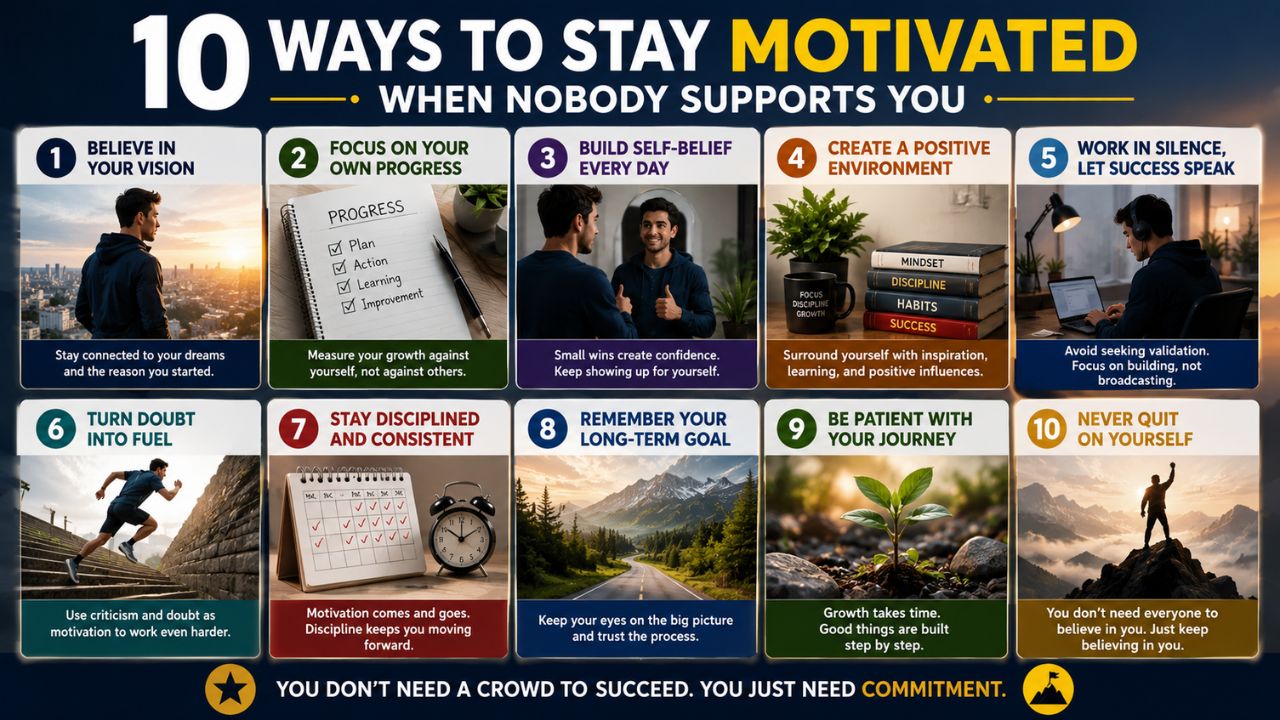
How to Stay Motivated When Nobody Supports You
The challenge of staying motivated becomes much greater when external encouragement disappears. During these moments, many people discover that their motivation was tied to validation rather than purpose. As long as others were supportive, they felt energized. When support vanished, so did their enthusiasm.
Lasting motivation comes from something deeper. It comes from having a reason that is strong enough to survive difficult circumstances. When your goal is connected to something meaningful, criticism becomes easier to handle because your purpose is larger than temporary setbacks.
One helpful approach is to regularly remind yourself why you started. Think about the life you want to create and the opportunities you hope to build. Consider the skills you want to develop and the person you want to become. These reasons can provide strength during periods when progress feels slow.
Motivation is not about feeling excited every day. It is about remaining committed even when excitement fades. The individuals who achieve extraordinary things are not always the most motivated. They are often the most committed.
The Power of Focusing on Progress Instead of Validation
Many people measure their success based on how much attention they receive. They judge their progress by the number of compliments, likes, followers, or encouraging comments they get from others. While recognition can feel rewarding, it is an unreliable source of motivation because it depends on factors outside your control.
Progress is a far better measurement. Progress is something you can influence directly through your actions. Every skill you improve, every lesson you learn, and every challenge you overcome represents genuine growth regardless of whether anyone notices.
Small improvements may not seem significant in the moment, but they accumulate over time. A single workout does not transform a body. A single article does not create a successful blog. A single day of effort does not build a business. Yet consistent effort over months and years can produce remarkable results.
When you focus on progress rather than validation, you gain a sense of control. Your motivation becomes less dependent on other people’s reactions and more connected to your own development.
Learning to Work in Silence
One of the most valuable skills you can develop is the ability to work without immediate recognition. Many people enjoy the idea of success, but far fewer enjoy the process required to achieve it. The process is often repetitive, difficult, and invisible to everyone except the person doing the work.
The author spends months writing before readers discover the book. The entrepreneur invests countless hours before customers begin arriving. The athlete trains long before competitions are won. Success is often built during periods when nobody is paying attention.
Working in silence teaches patience. It helps you focus on the quality of your efforts rather than the amount of attention you receive. It encourages mastery rather than performance. Most importantly, it allows you to develop resilience because your commitment is no longer dependent on applause.
Many of the people you admire today spent years improving their craft before anyone noticed them. Their success did not begin when recognition arrived. It began when they continued working despite the absence of recognition.
Why Failure Is Not the Enemy
Fear of failure prevents countless people from pursuing meaningful goals. They imagine embarrassing outcomes and convince themselves that avoiding risk is the safest option. Unfortunately, avoiding risk often creates a different kind of pain: regret.
Failure is not enjoyable, but it is rarely as destructive as people imagine. In most cases, failure provides valuable lessons. It highlights weaknesses, exposes mistakes, and reveals areas that need improvement. Without these lessons, growth becomes difficult.
The people who eventually achieve their goals are not individuals who avoid failure completely. They are individuals who learn how to respond to failure productively. Instead of viewing setbacks as evidence that they should quit, they view them as opportunities to adjust and improve.
Every successful person has experienced disappointment. What made the difference was their decision to continue learning rather than giving up.
Keep Going Long Enough to Surprise Yourself
Many dreams fail not because they are impossible but because people abandon them too soon. They underestimate how long meaningful progress takes and become discouraged when results do not appear quickly. In a world that celebrates instant success, patience has become a rare advantage.
Growth often happens slowly before it happens suddenly. Months of effort may seem to produce little change, but those efforts are building a foundation. Then, seemingly overnight, progress becomes visible. What looks like sudden success is usually the result of years of consistent work.
This is why persistence matters. The longer you continue learning, improving, and adapting, the greater the chances of creating opportunities that did not previously exist. Many people quit just before their efforts begin producing results.
If you remain committed long enough, you may surprise yourself with what you are capable of achieving. The future has a way of rewarding those who continue showing up long after others have stopped trying.