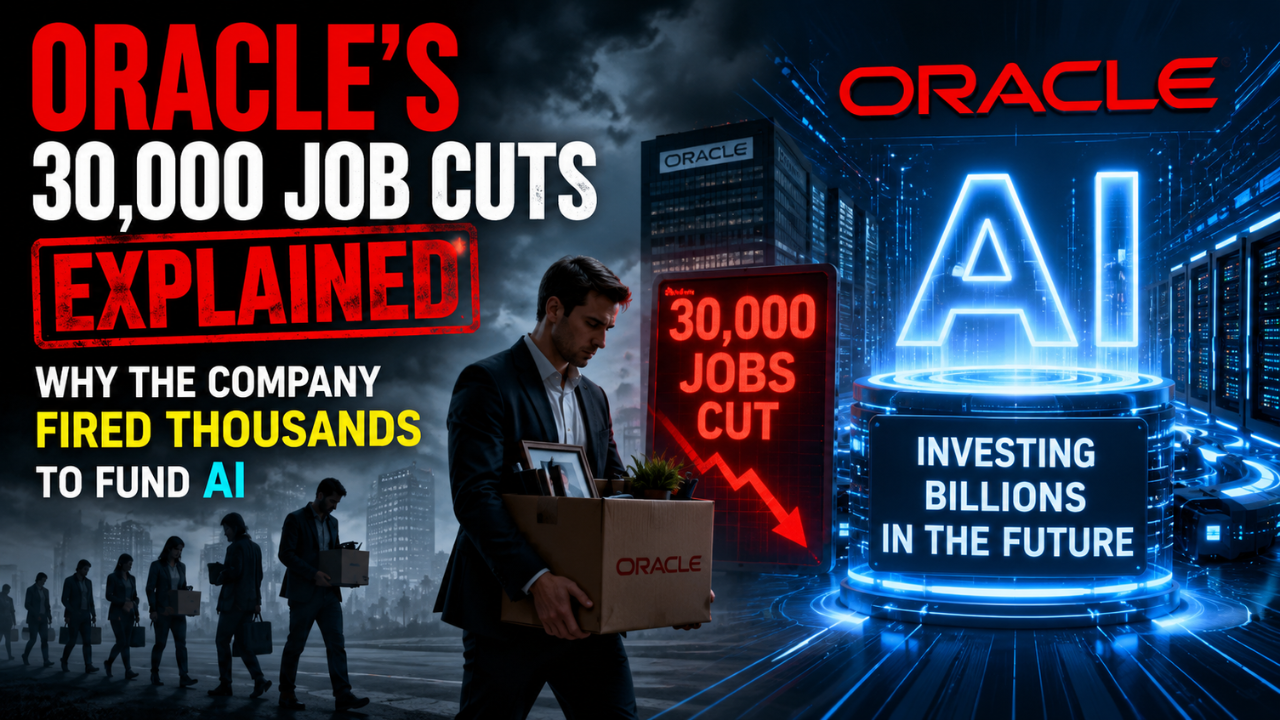
On the morning of March 31, 2026, thousands of Oracle employees around the world opened an email at 6 a.m. and found out they no longer had a job. No warning, no phone call from a manager — just a message saying their role had been eliminated, effective immediately. It was the largest single-day job cut in the company’s 49-year history, and it wasn’t a sign of trouble. It was a deliberate bet on AI.
What is happening?
Oracle laid off a massive portion of its global workforce in a single coordinated action. According to CX Today, while Oracle has never confirmed an exact figure, investment bank TD Cowen estimated the cuts affected between 20,000 and 30,000 employees — roughly 18.5% of Oracle’s global workforce of approximately 162,000 people.
The way it happened became a story in itself. As Tech Insider reported, at approximately 6:00 a.m. EST on Tuesday, March 31, thousands of employees across the United States, India, Canada, Mexico, and Uruguay received termination emails with no prior warning. The message was blunt: “After careful consideration of Oracle’s current business needs, we have made the decision to eliminate your role as part of a broader organizational change. As a result, today is your last working day.” One affected employee, Principal Product Manager Venkatraman Raguraman, described the shock on LinkedIn, as noted by CX Today: “Today, I’m sharing something I didn’t expect to say so soon — I’ve been impacted by a layoff at Oracle.”
The cuts weren’t scattered evenly. According to The Next Web, entire teams within Oracle’s Revenue and Health Sciences (RHS) and SaaS and Virtual Operations Services (SVOS) divisions saw reductions of at least 30%. In the US, affected workers spanned software engineers, account executives, program managers, and staff across Oracle Health, Sales, Cloud, Customer Success, and NetSuite divisions, as detailed by Tech Insider.
Why did this happen?
The rationale isn’t hidden — it’s about redirecting money, not cutting costs out of distress. According to The Next Web, Oracle has committed to an aggressive AI infrastructure buildout requiring an estimated $156 billion in capital spending. To help fund it, the company raised $45-50 billion in debt and equity financing in 2026 alone for Oracle Cloud Infrastructure, and the workforce reductions were expected to free up a further $8-10 billion in annual cash flow.
Oracle’s own leadership was unusually direct about the logic once the news broke. As Tech Insider reported, Oracle didn’t issue a press release on the layoffs themselves, but CEO Safra Catz acknowledged the action during a private analyst call on April 2, describing it as “a generational reallocation of capital from people-intensive consulting and legacy support toward GPU-intensive AI infrastructure.” Co-founder Larry Ellison was blunter still, in a separate investor briefing the same day: “We are choosing the chips. Anyone whose job is not making the chips run faster for our customers is at risk in this industry.”
That framing matters. This wasn’t Oracle in financial trouble — the same reporting noted cloud revenue had grown 44% in Q3 of fiscal year 2026. This was a healthy company deliberately trading one kind of workforce for another.
The AI bet behind the decision
To understand why Oracle would fire 30,000 people while its cloud business was growing, you have to understand what it’s building. According to Tech Insider’s deeper analysis, Oracle raised approximately $30 billion in debt and equity in February 2026 alone, pushing its total debt to $134.6 billion — a level that has begun drawing scrutiny from ratings agencies Moody’s and S&P.
The reason for that debt load is Oracle’s central role in the “Stargate” project, a massive AI data center partnership with OpenAI and SoftBank. That partnership is also where the risk lives. Patrick Moorhead, founder of Moor Insights & Strategy, put the exposure starkly in an April 3 note cited by Tech Insider: “Oracle is now structurally exposed to OpenAI’s revenue trajectory. If OpenAI cannot grow from its 2025 run-rate of roughly $13 billion to $200 billion+ by 2030, Oracle’s $300 billion contract becomes a liability rather than an asset. The 30,000-job cut amplifies that exposure — there is no soft underbelly of consulting revenue to absorb the shock.”
In plain terms: Oracle bet an enormous amount of borrowed money, and 30,000 jobs, on the belief that AI infrastructure demand will keep growing fast enough to justify it. If that bet is right, Oracle emerges as one of the most important infrastructure providers of the AI era. If it’s wrong, the same reporting suggests the company has removed its own cushion for absorbing the shock.
Who is affected and how?
India absorbed by far the heaviest share of these cuts. According to Tech Insider’s reporting, citing the Economic Times, approximately 12,000 employees were terminated out of Oracle’s roughly 30,000-person Indian workforce — a figure confirmed elsewhere as close to 40% of Oracle’s entire India-based workforce, concentrated in Bengaluru, Pune, and Hyderabad.
For the individuals affected, the terms were relatively defined but the emotional impact was severe given the lack of warning. According to KORE1’s guide for affected workers, severance ran four weeks of base pay plus one week per year of service, capped at 26 weeks. The same source noted that most displaced senior engineers were landing in mid-market and private-equity-backed roles within 17 to 30 days — a relatively fast rebound for specialized tech talent, though thousands of workers still hit the market simultaneously, intensifying competition. CX Today noted that the tech job market in Q2 2026 has remained challenging for displaced workers, particularly those with Oracle-specific skill sets competing against thousands of similarly qualified peers for the same roles.
The move also fits inside a broader pattern across the tech industry. KORE1’s analysis points out that Oracle is “the clearest example of cutting to fund AI infrastructure,” but it isn’t alone — IBM’s 2026 layoffs followed a similar pattern, cutting 9,000 US roles around the same period, part of a wider wave of AI-driven restructuring rippling through enterprise technology in 2026.
The optics problem this created
Beyond the financial logic, the manner of the layoffs became its own story. Tech Insider reported that the cuts had been telegraphed weeks earlier — Bloomberg first reported on March 5 that Oracle was planning to “ax thousands of jobs” to handle a “cash crunch from a massive AI data center expansion effort.” But the speed and manner of the actual execution — early morning termination emails with same-day effect and no advance conversation — caught many longtime employees off guard and triggered a wave of public posts on LinkedIn, Reddit’s r/employeesOfOracle, and the professional forum Blind, as multiple outlets including CX Today documented.
That combination — a financially healthy company, a bet on a still-unproven AI revenue trajectory, and a workforce reduction executed with unusually little warning — is what turned a standard corporate restructuring into one of the most discussed layoff events of 2026.
What happens next?
Three things are worth watching from here.
Whether the AI bet pays off. Oracle’s entire rationale rests on AI infrastructure demand, and specifically OpenAI’s ability to grow its revenue enormously by 2030 to justify Oracle’s $300 billion Stargate contract. If that growth materializes, the layoffs will likely be remembered as an aggressive but effective pivot. If it doesn’t, Oracle’s debt load and reduced consulting revenue could leave it more exposed than before.
Whether other enterprise tech companies follow the same playbook. With IBM already cutting 9,000 roles in a similar pattern, Oracle’s approach — trading legacy, people-intensive divisions for capital-intensive AI infrastructure — may become a template other large tech firms follow through the rest of 2026.
How India’s tech labor market absorbs the shock. With roughly 40% of Oracle’s India workforce cut in Bengaluru, Pune, and Hyderabad alone, the local hiring markets in those cities are a genuine test of how quickly India’s tech sector can reabsorb a sudden, concentrated wave of experienced talent.
Key takeaway
- Oracle cut an estimated 20,000-30,000 jobs — about 18.5% of its global workforce — on March 31, 2026, in the largest single-day layoff in its history, to free up $8-10 billion a year for its AI infrastructure buildout
- The company wasn’t in financial distress — cloud revenue grew 44% that quarter — this was a deliberate reallocation from “people-intensive consulting” toward “GPU-intensive AI infrastructure,” in CEO Safra Catz’s own words
- India absorbed the heaviest impact, with roughly 12,000 jobs cut (about 40% of Oracle’s Indian workforce) concentrated in Bengaluru, Pune, and Hyderabad, while the entire bet hinges on whether OpenAI’s revenue can grow enough to justify Oracle’s $300 billion Stargate contract