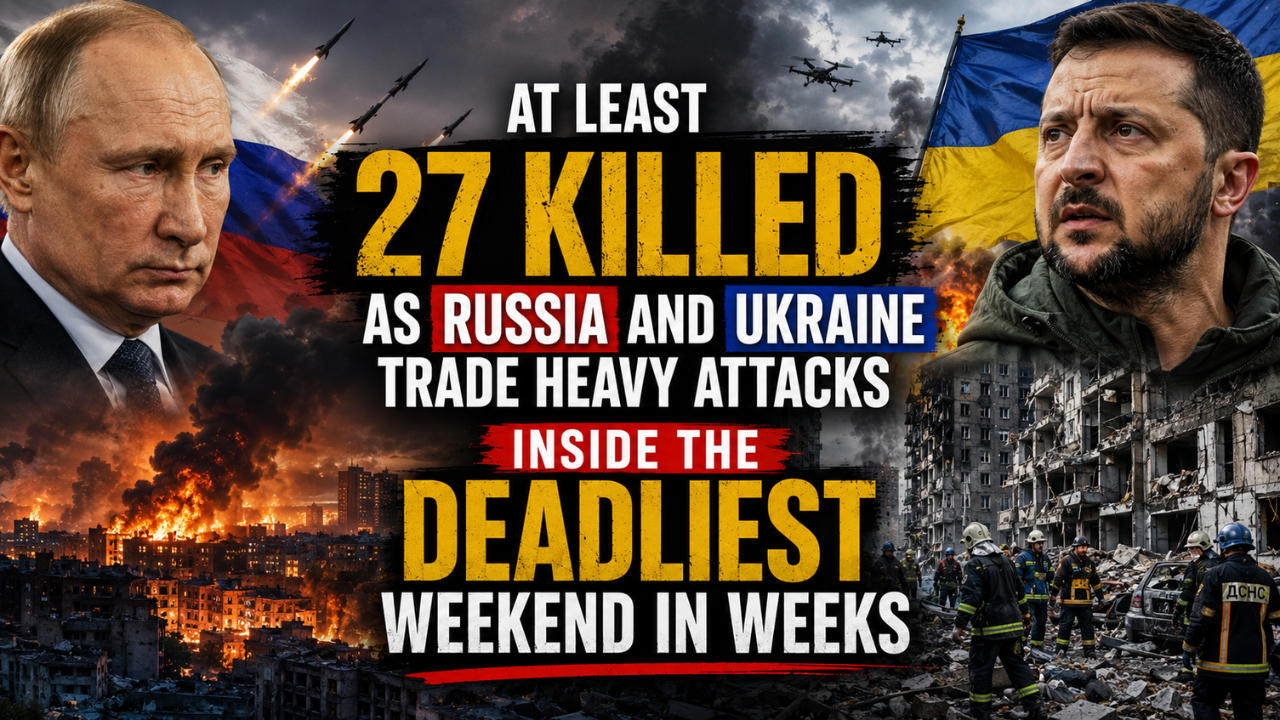
Sixteen people dead in Russia. Eleven dead in Ukraine. Among them, an eight-year-old boy killed alongside his father, an emergency responder, at a petrol station. This is what a single 48-hour stretch of the Russia-Ukraine war looked like in early August 2026, a war that has been escalating on both sides of the front line, not just at it.
What is happening?
Russia and Ukraine exchanged heavy attacks over the weekend of August 1-3, 2026, killing at least 27 people combined. According to Al Jazeera, at least 16 people were killed in Russia and 11 in Ukraine, according to local officials from each side, as both countries continued to exchange attacks into Tuesday, August 3.
The Russian toll came from multiple separate strikes. Al Jazeera reported that Russian state news agency TASS said five people were killed in a drone attack in the Moscow region early Tuesday, with six others injured. Separately, the governor of Russia’s southern Krasnodar region said seven people, including three children, were killed and nearly 40 wounded when drone debris fell on the resort village of Arkhipo-Osipovka near Gelendzhik. In Russian-occupied Crimea, the Moscow-installed regional head reported the death toll there had risen to four, with two others injured.
On the Ukrainian side, the deaths were concentrated in two separate strikes. According to the same Al Jazeera report, three people, including an emergency response worker and his eight-year-old son, were killed in a Russian attack on a petrol station in the Kryvyi Rih district of the Dnipropetrovsk region, an area repeatedly targeted throughout the war. Regional Governor Oleksandr Hanzha said the attack sparked a fire that damaged the station and nearby vehicles, with 21 people, including three children, rushed to hospital and nine in serious condition. Separately, eight people, including two children, were killed in an overnight attack in Zaporizhzhia.
Why did this happen?
This weekend’s toll fits a clear and worsening pattern that has defined the war’s trajectory in recent months. According to Al Jazeera’s coverage from the same week, data compiled by AFP from Ukrainian Air Force reports showed Russia fired a record 376 missiles at Ukraine in July alone, more than double the total launched in June, with most aimed at Kyiv. That intensified ballistic campaign killed more than 170 civilians between July 1 and July 27 alone, according to United Nations figures.
Both countries have also expanded where they’re willing to strike. The same report noted that Russian and Ukrainian forces are increasingly using long-range missiles and drones to attack each other far beyond the front lines. Ukrainian drones have struck targets in Russian regions more than 1,300 kilometers from the front, while Russia has continued striking deep into Ukrainian territory, well past the contact line where the actual ground war is being fought.
Part of what’s making Russian strikes more lethal recently is a specific capability gap on Ukraine’s side. According to CNBC, President Zelenskyy said Ukraine has run out of interceptor missiles for its US-made Patriot air defense systems, and during one recent attack involving 35 missiles, 27 of them ballistic, only one was intercepted, “simply because there are no interceptors for the Patriot system.” Zelenskyy directly linked that shortage to the Iran war, explaining that supplies of interceptor missiles previously earmarked for Ukraine have been diverted to the US military and its allies in the Gulf as that separate conflict has consumed American military resources and attention.
Who is affected and how?
Civilians are increasingly bearing the brunt on both sides of this war, and the numbers back that up starkly. According to Al Jazeera’s reporting from late July, UN officials say 1,396 civilians were killed and 7,978 wounded in Ukraine in just the first six months of 2026, while in Russia, 250 civilians were killed and 1,596 injured over the same period. Analysts cited in that report attribute the sharply rising civilian casualty rate on both sides to the growing use of short-range drones, glide bombs, and intensified strikes on infrastructure, rather than purely front-line combat.
Both governments continue to publicly deny deliberately targeting civilians, even as the human cost climbs. That denial sits uneasily against the specifics of recent strikes: a petrol station where families were fueling cars, a residential area in Zaporizhzhia, a resort village where drone debris killed three children in a single incident.
The diplomatic backdrop makes the continued violence even more stark. Efforts to end the fighting have not produced results recently; the same Al Jazeera report from July 27 noted that United States-led talks on ending the fighting have stalled, even as both sides continue exchanging increasingly lethal long-range strikes.
What happens next?
Whether Ukraine’s Patriot interceptor shortage gets resolved. With Zelenskyy directly attributing Ukraine’s reduced ability to intercept Russian ballistic missiles to a diversion of supplies toward the Iran war, any resolution or de-escalation of that separate Middle East conflict could directly affect how many interceptors become available to Ukraine again.
Whether the July missile-launch pace continues into August. With Russia’s July missile launches more than doubling June’s total, whether that intensified pace continues, plateaus, or escalates further in August will be a key indicator of where this phase of the war is headed.
Whether stalled US-led talks resume. With both sides continuing to exchange increasingly lethal long-range strikes even as diplomatic efforts remain stalled, any renewed push for negotiations will need to contend with a war that is, by the numbers, currently escalating rather than winding down.
Key takeaway
- At least 27 people were killed over the weekend of August 1-3, 2026, as Russia and Ukraine exchanged heavy attacks: 16 in Russia, including three children in a single drone-debris incident, and 11 in Ukraine, including an eight-year-old boy.
- Russia fired a record 376 missiles at Ukraine in July 2026 alone, more than double June’s total, killing over 170 civilians in that month according to UN figures, as both sides increasingly strike targets far beyond the front lin.e
- Ukraine says it has run out of interceptor missiles for its US Patriot air defense systems, with President Zelenskyy directly linking the shortage to supplies being diverted toward the separate Iran war