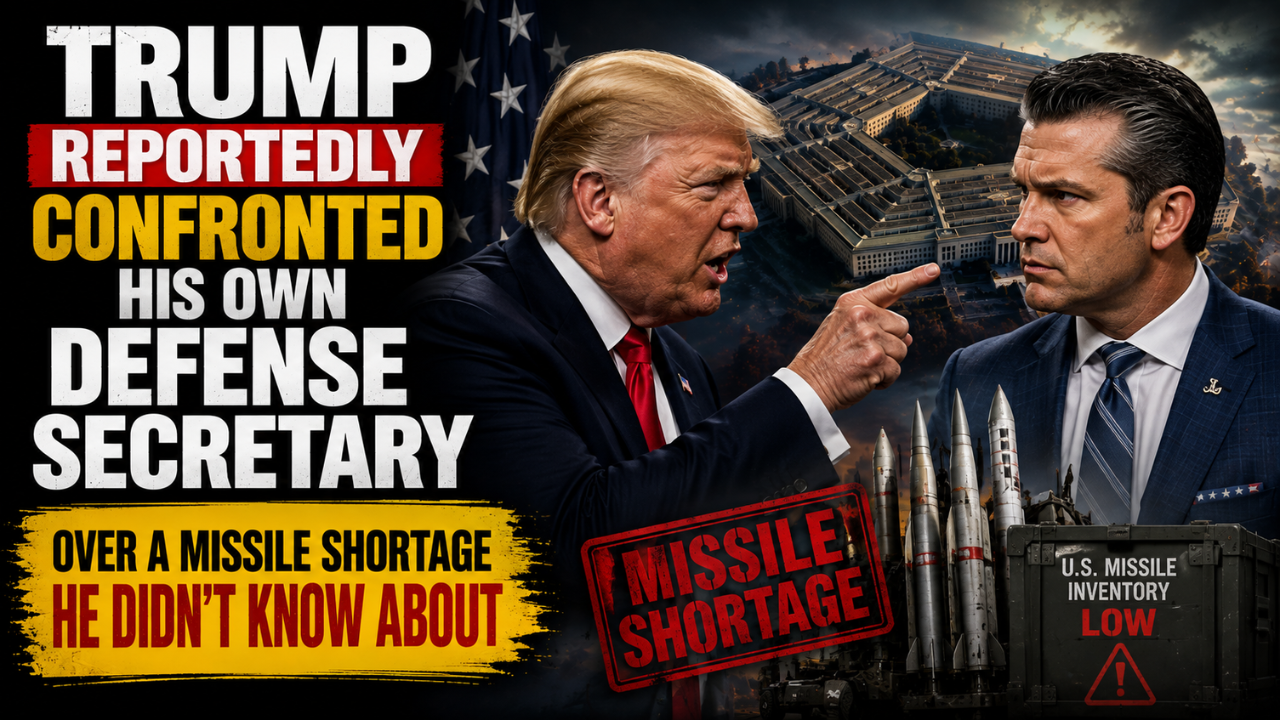
The President thought the problem had been fixed. It hadn’t. According to a new Washington Post report, Donald Trump confronted Defense Secretary Pete Hegseth at Camp David last week over a severe shortage of long-range missiles — a shortage that has reportedly already shaped decisions about when and how the US can strike Iran. The White House says none of it happened.
What is happening?
A reported clash between President Trump and Defense Secretary Pete Hegseth over depleted US missile stockpiles has become a public controversy, with the White House forcefully denying the account. According to the Tribune, citing the Washington Post, tensions over US military stockpiles amid the conflict with Iran reportedly escalated at Camp David last week, where Trump confronted Hegseth over concerns about severe munitions shortages that could limit Washington’s future military options against Iran.
The specifics of the confrontation, as reported, were pointed. According to the Times of Israel’s coverage of the same Washington Post report, Trump told Hegseth he thought the shortage of long-range and interceptor missiles “had been fixed” — suggesting the president believed the problem had already been resolved before learning it hadn’t been. According to the Tribune, two people familiar with the matter said Trump confronted Hegseth over what he viewed as “extreme munitions shortages,” while Hegseth, in turn, reportedly defended his position and attributed responsibility elsewhere.
The White House response has been blunt and immediate. According to ANI News, White House Press Secretary Karoline Leavitt posted on X: “I was at Camp David with President Trump and Secretary Hegseth. This literally never happened, and we told the Washington Post that repeatedly. This B.S. story was shopped to many outlets by someone clearly out to disparage the Secretary… FAKE NEWS!” Pentagon spokesman Sean Parnell echoed the denial in his own post, calling the story “fake, anonymously sourced BS” that the Post ran with anyway.
Why did this happen?
Behind the denials sits a set of numbers that multiple outlets have independently confirmed, and they’re stark. According to the Jerusalem Post, the Washington Post found that in just the first month of the conflict with Iran, the US had fired more than 850 Tomahawk cruise missiles, over 1,000 Terminal High Altitude Area Defense (THAAD) missiles, and at least 1,300 tactical ballistic missiles — and that the US Army had used up “virtually all” of its stockpile of highly accurate long-range missiles during the five-month war.
A separate Reuters report, cited by Ynetnews, specified exactly which weapons systems are most depleted: Army Tactical Missile Systems (ATACMS) and Precision Strike Missiles (PrSM), with two sources telling Reuters the US had used “almost all” of those particular weapons. Ynetnews reported this had not previously been disclosed in such detail.
There was also, notably, an explicit warning that reportedly went unheeded before the war even began. The same Ynetnews report noted that Joint Chiefs of Staff Chairman Gen. Dan Caine had warned the president before the war started that the United States did not have sufficient munitions stockpiles to sustain a prolonged conflict — meaning if the current shortage report is accurate, it would represent a risk that was flagged in advance rather than one that emerged unexpectedly.
The political dimension adds further context. According to Ynetnews, during a Senate hearing in July, Hegseth clashed with Democratic senators over whether he had given Trump honest assessments of the risks a prolonged Iran campaign posed to US military inventories — and during that hearing, Hegseth declined to discuss the specific advice he’d given the president, instead repeatedly attributing any shortages to how the Biden administration had previously managed the military, rather than to decisions made under the current administration.
Who is affected and how?
For US military readiness more broadly, the reported shortage carries real strategic weight beyond the Iran conflict itself. Ynetnews noted the depletion of some missile stockpiles has also raised concerns about the ability to support allies, including Ukraine — a direct link to the Patriot interceptor shortage Ukraine’s own president has publicly cited as limiting Ukraine’s air defense against Russian strikes, a story we’ve covered separately as it’s unfolded.
For the Pentagon’s own budget request, the reported shortage lines up directly with what officials have already asked Congress for. According to Ynetnews, Hegseth, along with Deputy Secretary Feinberg and Gen. Caine, asked lawmakers to approve an additional $67 billion in military funding specifically to cover the cost of the Iran war, with Hegseth describing the request as addressing an “urgent, necessary” need to replenish stockpiles — a request that becomes considerably more urgent if the reported Camp David confrontation and underlying shortage numbers are accurate.
For the war with Iran itself, the timing is genuinely significant. According to Israel Hayom, the shortage — particularly of long-range guided cruise missiles and air-defense interceptors — was reportedly among the factors that led Trump to hold off in recent days from ordering additional large-scale strikes against Iran. That connects directly to the story we’ve already covered this week: Trump’s decision to cancel what he called “the biggest attack since World War II,” which he attributed publicly to progress in negotiations over reopening the Strait of Hormuz. This new reporting suggests munitions constraints may have been a quieter, unstated factor in that same decision.
Trump’s own public response to the underlying data has been to reject the premise entirely rather than engage with the specific numbers. According to the Jerusalem Post, when asked for comment on the stockpile figures, the White House issued a statement from Trump asserting the US had “far more munitions than anyone in the world” and “far more than we need,” adding that American defense companies were “making more munitions than they have ever made before, in addition to expanding their plants and equipment at record levels.”
What happens next?
Whether Congress approves the requested $67 billion. With Pentagon officials already framing the additional funding as urgent and necessary to replenish stockpiles, how quickly — and whether — Congress moves on that request will be a real-world indicator of how seriously lawmakers take the underlying shortage claims, regardless of how the Trump-Hegseth confrontation story itself is resolved.
Whether military options against Iran remain constrained. If the reported munitions shortage is accurate and factored into recent decisions to hold off on further strikes, it could continue shaping US strategy toward Iran even as diplomatic talks and the Oman-mediated Hormuz negotiations continue in parallel.
Whether the Hegseth-Trump relationship shows further strain. Despite the White House’s forceful denial and insistence that Trump “has full confidence in Secretary Hegseth,” continued reporting on internal administration tensions — layered on top of Hegseth’s contentious July Senate testimony — is a storyline worth watching for signs of whether this was an isolated incident or part of a larger pattern.
Key takeaway
- The Washington Post reported that Trump confronted Defense Secretary Hegseth at Camp David over severe missile shortages he believed had already been fixed, a claim the White House has forcefully and repeatedly denied as “fake news”
- Independent reporting confirms the US fired over 850 Tomahawk missiles, 1,000+ THAAD interceptors, and 1,300+ tactical ballistic missiles in the first month of the Iran war alone, with the Army having used “virtually all” of its ATACMS and Precision Strike Missile stockpiles
- The reported shortage may have quietly influenced Trump’s recent decision to cancel a planned major strike on Iran, and it connects directly to a separate munitions shortage Ukraine has cited as limiting its own air defenses against Russia