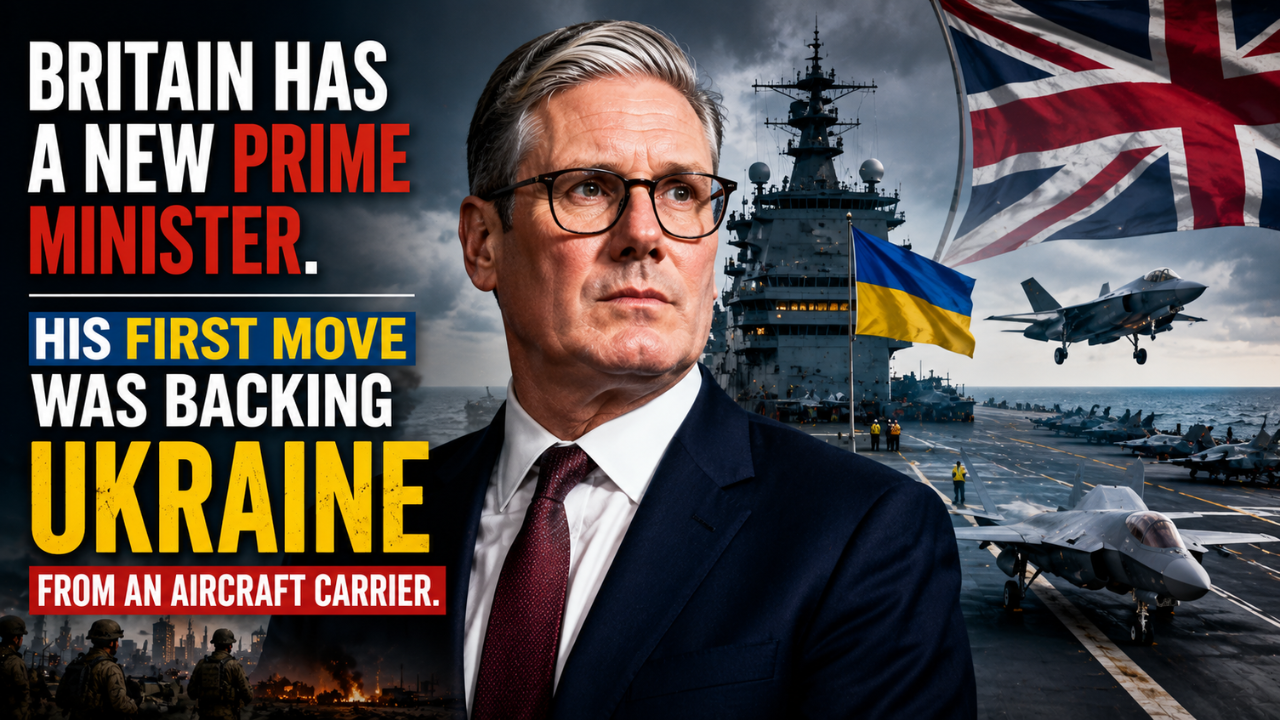
A week into the job, Britain’s new Prime Minister Andy Burnham had a choice to make about who gets his first foreign meeting. He chose Volodymyr Zelenskyy and staged it aboard one of the Royal Navy’s largest warships. Hours later, Zelenskyy was headed to Washington for a meeting with Trump that could shape the next phase of a war now in its fifth year.
What is happening?
Britain’s new Prime Minister Andy Burnham hosted Ukrainian President Volodymyr Zelenskyy on July 27, 2026, in his first bilateral meeting with any foreign leader since taking office. According to Al Jazeera, Burnham’s first bilateral meeting with a foreign leader was held as Zelenskyy stopped off in England en route to Washington, DC, where he heads to discuss efforts to end Russia’s war on his country, now in its fifth year.
The choice of venue was deliberately symbolic. According to Euronews, the meeting took place aboard the aircraft carrier HMS Queen Elizabeth, docked in Portsmouth on England’s south coast, where the two leaders also met with more than 200 Ukrainian military personnel who have spent three weeks training in Britain to strengthen their fighting capabilities and counter-mine operations in the Black Sea. Burnham was direct about his intentions, telling Zelenskyy: “You are the first leader I have welcomed in person since taking office, and that is no accident. It is intended to send a very clear message: we are with Ukraine 100%, I am personally with you 100%, and I will honor every commitment this country has made to Ukraine in full.”
The meeting produced a concrete commitment, not just symbolism. According to ABC News, the UK will give Ukraine the intellectual property behind its new “Stone Cloak” electronic warfare system, which is capable of jamming Russian air defenses to stop drones from being detected.
Why did this happen?
Burnham’s position is unusual precisely because of how recently he arrived in office. According to Bloomberg, the visit was a signal from the UK of its continued support for Ukraine despite Keir Starmer’s recent exit as premier, and it also enabled British officials to help Zelenskyy prepare for his upcoming US visit, which comes amid efforts to revive talks to end the war with Russia.
Burnham inherits a role with real continuity behind it. As Al Jazeera noted, Burnham is the fifth British prime minister to deal with President Zelenskyy since the war in Ukraine started in 2022, a reminder of how many UK governments have cycled through during a conflict that has now stretched into its fifth year. ABC News added that his predecessor, Keir Starmer, was in Kyiv less than two weeks earlier, on his last overseas trip before leaving office, meaning UK support for Ukraine has been treated as a continuous, cross-government commitment rather than something that resets with each new prime minister.
There’s also real urgency behind the timing. Al Jazeera reported that Zelenskyy continues to call for help defending his country as US-led ceasefire negotiations have slowed while Washington’s attention has been diverted to the Iran war, meaning Ukraine’s war risks losing diplomatic bandwidth in Washington at exactly the moment Zelenskyy needs it most.
Who is affected and how?
For Ukraine specifically, the meeting delivered both military hardware commitments and diplomatic momentum ahead of the higher-stakes Trump meeting. According to Euronews, Burnham said the two leaders had “talked at length” about Kyiv’s need for more interceptors to shoot down Russian ballistic missiles, “particularly in terms of Ukraine protecting critical national infrastructure during the winters,” a direct reference to Russia’s ongoing campaign against Ukraine’s power grid. Burnham added after the meeting: “We’ve taken away some things that we will now follow up with our partners,” signaling further commitments are still being worked out with allies.
There’s a separate, escalating front to this story that adds real tension. According to France 24, Iranian Foreign Minister Abbas Araghchi said Ukraine struck an Iranian vessel in the Caspian Sea over the weekend, killing a sailor, and denounced the attack as a “blatant UN Charter violation done at Israel’s behest to drag Europe into its war.” Zelenskyy, for his part, said on X that the Caspian Sea strikes achieved “very good results,” with targets including “vessels involved in transporting military cargo linked to Iran, as well as a warship.” Ukraine’s Foreign Minister Andrii Sybiha rejected Iran’s retaliation threats as unjustified, pointing to Tehran’s weapons supplies to Russia. That exchange shows Ukraine’s war is no longer a two-country conflict in any simple sense;e it now has direct friction with Iran layered on top of the existing fight against Russia.
For Britain, the symbolism carries its own domestic weight. Hosting Zelenskyy first, ahead of any other foreign leader, was a calculated move by a brand-new government to signal continuity and resolve on an issue where UK policy has remained consistent across five different prime ministers, regardless of domestic political turnover.
What happens next?
The Trump-Zelenskyy meeting in Washington. As Al Jazeera reported, Zelenskyy’s UK stop came directly before his trip to Washington, DC, on July 2 for a new bid to end Russia’s war on Ukraine. The outcome of that meeting will likely shape the next phase of ceasefire negotiations far more than the UK visit itself.
Whether the Iran-Ukraine friction escalates further. With Iran calling Ukraine’s Caspian Sea strike a violation that “can’t go unanswered,” and Ukraine defending the strikes as legitimate given Iran’s weapons support for Russia, this secondary front could complicate broader diplomatic efforts if it continues to intensify.
Whether British military support translates into further allied commitments. Burnham’s comment that the UK will “follow up with our partners” suggests the Stone Cloak transfer and interceptor discussions may be the opening move in a broader coordinated push among Ukraine’s Western allies, rather than a standalone gesture.
Key takeaway
- New UK Prime Minister Andy Burnham chose Ukrainian President Zelenskyy as his first foreign leader meeting, hosting him aboard the aircraft carrier HMS Queen Elizabeth on July 27, 2026, and pledging to transfer the UK’s “Stone Cloak” electronic warfare system to Ukraine.
- Burnham is the fifth British prime minister to deal with Zelenskyy since Russia’s 2022 invasion, and the meeting came directly ahead of Zelenskyy’s July 28 trip to Washington to meet President Trump.p
- A separate flashpoint is escalating alongside the main war: Ukraine struck an Iranian vessel in the Caspian Sea, killing a sailor, which Iran has called a violation that “can’t go unanswered, ed” adding a new dimension of risk to an already complex conflict