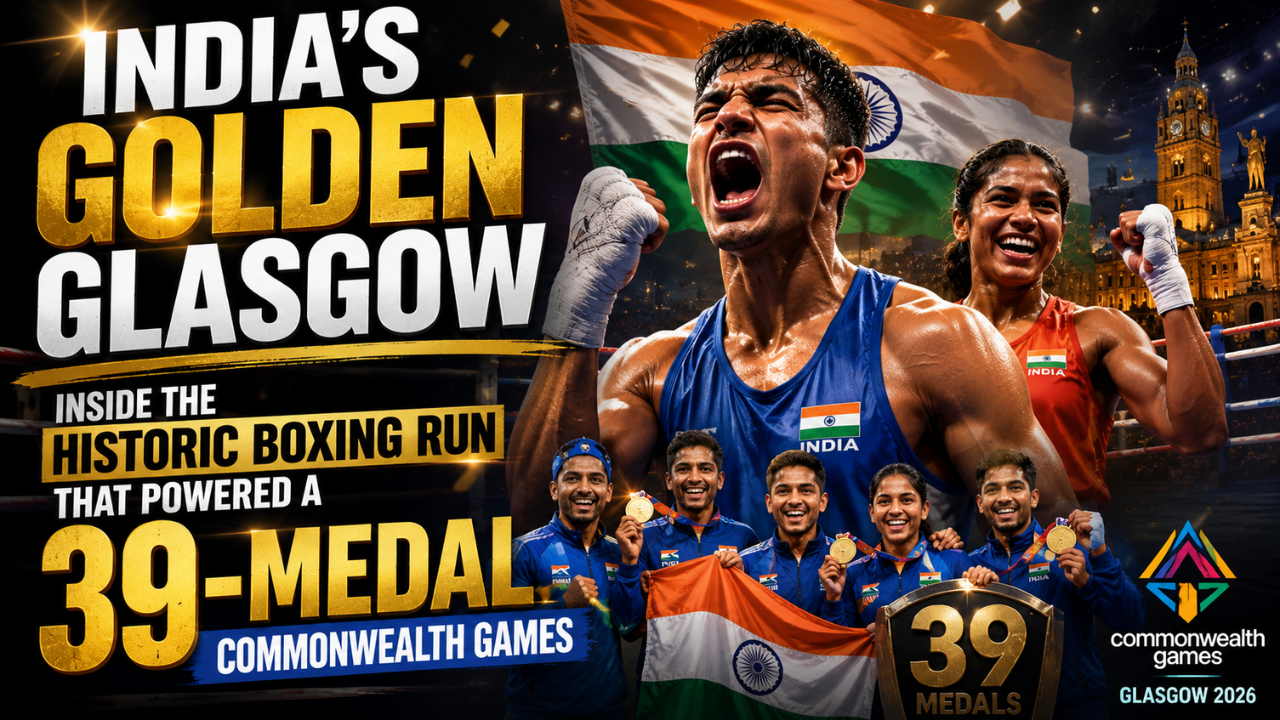
India came into Glasgow 2026 with a smaller squad and lower expectations than usual, competing in a Commonwealth Games stripped of several of its traditionally strongest sports. It left with 39 medals, a historic boxing campaign, and a message about the changing face of Indian sport: eight of India’s 13 golds came from women.
What is happening?
India has concluded the 2026 Commonwealth Games in Glasgow with 39 total medals 13 gold, 17 silver, and nine bronze finishing fourth in the overall standings. According to Olympics.com, the Games ran from July 23 to August 2, and India achieved this tally despite competing in a significantly reduced programme that excluded traditionally medal-rich sports for India, including wrestling, badminton, table tennis, hockey, and shooting.
Boxing was the standout story of India’s entire campaign. The same report noted boxing spearheaded India’s medal count with a record 10 medals, including an unprecedented seven golds, the most gold medals won by any nation in boxing at a single Commonwealth Games. According to World Boxing’s own coverage, India topped the boxing medal table after winning seven of the 10 finals it competed in on a single, decisive day of action at the Scottish Event Centre, five of seven women’s categories and two of the men’s, with England the next-best performer, matching India’s overall medal count of 10 but with only four golds to India’s seven.
Why did this happen?
The final tally has to be understood against a genuinely reduced competition format, which reshaped expectations for every nation, not just India. According to ESPN’s coverage, India had won 61 medals, including 22 gold, at the 2022 Birmingham Games, but 30 of those 61 medals came from sports that simply weren’t part of the Glasgow 2026 programme at all. With wrestling, badminton, table tennis, and hockey all absent this time, a smaller overall medal count was expected well before competition even began, meaning boxing’s historic seven-gold haul effectively filled a gap that other traditionally strong Indian sports would normally have covered.
There’s a deeper structural story behind who actually delivered those medals. According to the Indian Olympic Association’s own recap, published August 2 under the headline “Nari Shakti Powers Team India’s Golden Campaign,” eight of India’s 13 gold medals came from women athletes a detail the IOA itself framed as reflecting the broader rise of women in Indian sport, not just a one-off statistical quirk of this particular Games.
Individual results back up that framing throughout the tournament. World Boxing’s day-by-day coverage recorded Preeti winning gold at bantamweight over Canada’s Scarlett Savannah Delgado, while Jaismine defeated defending champion Michaela Walsh of Northern Ireland at featherweight, notably adding the Commonwealth title to the World Boxing Championship gold she’d already won in Liverpool the previous September, a genuine world-to-Commonwealth double.
Who is affected and how?
For India’s boxing programme specifically, this represents a landmark moment. A seven-gold haul in a single discipline at one Commonwealth Games is an extraordinary concentration of success, and it establishes Indian boxing, particularly its women’s programme, as a genuine global force heading into future international competition, including the next Olympic cycle.
Beyond boxing, other disciplines delivered milestone moments of their own. According to Olympics.com’s live Day 8 coverage, Asmita Dey and Harsh Singh became India’s first-ever judokas to win gold medals in Commonwealth Games history, while Yamini Mourya added a silver in the same discipline a genuine breakthrough for a sport where India had no prior Commonwealth Games gold medal history at all.
Athletics delivered its own storyline, even without gold at the very top. The same report recorded that two-time Olympic and world javelin champion Neeraj Chopra won silver with a throw of 85.83m, with Yash Vir Singh taking bronze in the same event at a personal-best 85.41m, giving India a double podium finish in one of its most closely watched individual events of the entire Games. Tejaswin Shankar added a bronze in the decathlon on the same day, rounding out a genuinely strong single day for Indian athletics.
For India’s broader Commonwealth Games history, this result adds meaningfully to an already substantial legacy. According to ESPN’s tracker, India have now won 564 medals across their Commonwealth Games history 203 gold, 190 silver, and 171 bronze the fourth-most of any nation to ever compete at the Games, with India’s all-time best campaign remaining the 101-medal haul at the 2010 Delhi Games, which India itself hosted.
What happens next?
The road to the next Commonwealth Games and beyond. With boxing and judo both delivering breakthrough or record performances in Glasgow, expect increased investment and attention on both disciplines as India builds toward the 2030 Commonwealth Games and the next Olympic cycle.
What “Glasgow’s legacy” actually means for Indian sport. The Indian Olympic Association’s own August 1 recap, titled “More Than Medals: The Legacy of Glasgow for Team India,” suggests Indian sporting officials are already framing this campaign as more than a medal count, likely pointing to grassroots development, the emergence of new disciplines like judo, and the continued rise of women athletes as the more durable outcomes of these Games.
How the reduced-sport format shapes future Commonwealth Games planning. With 30 of India’s 2022 medals coming from sports absent in 2026, how the Commonwealth Games Federation structures its sports programme going forward will directly shape which nations and which of India’s traditionally strong disciplines get a real chance to compete for medals next time.
Key takeaway
- India finished the 2026 Commonwealth Games in Glasgow with 39 total medals (13 gold, 17 silver, 9 bronze), placing fourth overall despite a reduced sports programme that excluded wrestling, badminton, table tennis, hockey, and shooting
- Boxing delivered a historic seven golds, the most by any nation in the sport at a single Commonwealth Games, while judo delivered India’s first-ever Commonwealth Games gold medals in that discipline
- Eight of India’s 13 gold medals came from women athletes, a result the Indian Olympic Association specifically highlighted as reflecting the broader rise of women in Indian sport