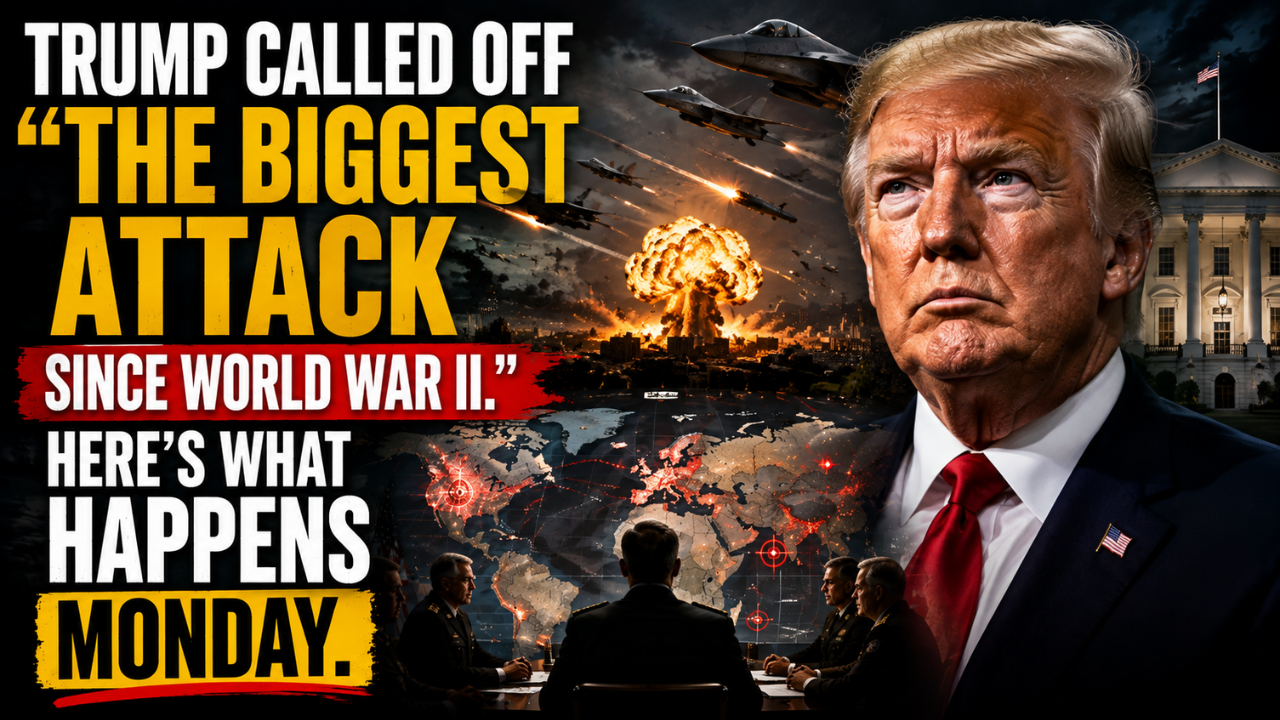
President Trump says he had a plan ready to launch the largest American military strike since 1945. Then, at the request of Saudi Arabia, the UAE, and Qatar, he called it off. Now new negotiations with Iran begin Monday the latest attempt to end a war that has already collapsed and restarted more times than anyone in the region can count.
What is happening?
President Trump announced on Saturday that he canceled a planned attack on Iran and that new negotiations with Tehran will begin Monday afternoon. According to CBS News, the United States and Israel had been planning what multiple sources described as one of the harshest bombing campaigns to date against Iranian energy infrastructure targets, before Trump called it off.
Trump was dramatic in describing what he’d called off. According to Bloomberg, speaking to reporters aboard Air Force One on Sunday, Trump said “it would have been the biggest attack since World War II” and that it would have been “disastrous” for Iran. According to ABC News, Trump said he called it off “at the request of” Saudi Arabia, the UAE, and Qatar and, notably, at the request of Iran itself. He also confirmed he had spoken directly with Saudi Arabia’s crown prince, who told him he would prefer a negotiated deal.
Trump was specific about what he expects any resulting deal to include. According to the Associated Press, Trump wrote in a Saturday evening social media post that the emerging deal “would include the Immediate, Complete, and Total OPENING OF THE HORMUZ STRAIT, and an end to Iran’s nuclear threat.”
Iran’s response has been notably cautious rather than celebratory. According to CBS News, Iran’s defense minister said on X that the country was “neither surprised nor passive” and remains on alert, and Al Jazeera’s live coverage noted Iranian state media gave no indication that Tehran had actually requested the attacks be called off, or that it had changed its position on the Strait of Hormuz.
Why did this happen?
To understand why this particular pause matters, it helps to see how many times this exact cycle has already played out. According to CNN’s ongoing timeline, the war has followed a pattern of repeated ceasefires and collapses: on July 10, Trump said the US would continue talks with Iran but also informed Tehran that a prior ceasefire was no longer in effect. On July 11, Iran’s foreign minister accused the US of violating the nuclear-program clause of their agreement. On July 12, Iran’s Revolutionary Guard announced it had closed the Strait of Hormuz entirely after firing a warning shot at a vessel, and the US responded with further strikes while insisting the strait remained open. This is now, by CNN’s own framing, a war that has dragged on for five months with negotiations repeatedly breaking down.
The current pause traces back to an earlier round of diplomacy. According to Cryptobriefing’s summary of the underlying agreement, the June 17, 2026 Memorandum of Understanding that formally concluded the initial phase of the war initiated a 60-day negotiation window specifically to address Iran’s nuclear program, sanctions relief, and the reopening of the Strait of Hormuz a window this weekend’s announcement now falls squarely within, as that deadline approaches.
The pressure driving this particular pause appears to be coming heavily from Gulf allies rather than from Washington or Tehran directly. Al Jazeera reported that Trump’s announcement came hours after Iranian Foreign Minister Abbas Araghchi held a second phone call with Saudi Arabia’s foreign minister, joined by Pakistan’s army commander, specifically to discuss diplomatic efforts and regional stability suggesting a coordinated push by regional powers, not just the two main combatants, to prevent renewed escalation.
Who is affected and how?
Iran’s negotiating position appears to be shaped significantly by domestic economic strain. CNN’s reporting noted that Iran’s unemployment has worsened since the conflict began, and its currency has hit new lows real pressure points that may be pushing Tehran toward the negotiating table even as its public statements project resolve rather than urgency.
The specific issue at the center of the talks the Strait of Hormuz has its own parallel negotiating track underway. According to ABC News, Iran’s Foreign Minister Abbas Araghchi said negotiations between Tehran and Oman over the strait are in their “final stages” and “on the way to being finalized.” Notably, Iranian Ministry of Foreign Affairs spokesperson Esmaeil Baghaei clarified that these Oman-mediated talks are focused on agreeing to a new shipping route through the strait, specifically stating this has “no link to the Strait of Hormuz being opened or closed” a distinction that suggests Iran may be negotiating narrower, technical fixes to shipping routes rather than a full and unconditional reopening of the waterway itself.
According to the Associated Press’s sourcing from a regional mediation official, the broader proposal on the table involves genuine reciprocal trade-offs: Iran would need to halt attacks across the region, including those by Iranian-backed militias in Iraq targeting Gulf countries and Jordan, while in exchange the US would end its naval blockade on Iranian ports and allow Tehran to resume exporting oil, as originally laid out in the tentative ceasefire deal reached earlier this summer.
For markets and prediction platforms tracking the odds of a resolution, sentiment has shifted modestly. According to Cryptobriefing, prediction markets tracking the likelihood of reconstruction funding being included in a formal US-Iran deal moved to 32.5% “yes” following the earlier June announcement reflecting real but still limited confidence that this round of talks will produce a durable, lasting agreement rather than another temporary pause.
What happens next?
Monday’s negotiations themselves. Trump gave no details about the venue or participants beyond confirming talks begin Monday afternoon, telling reporters: “Now what we’re doing is talking to them in the form of a negotiation. It begins tomorrow afternoon.” What actually gets discussed, and by whom, will become clearer once the session starts.
Whether this pause holds longer than previous ones. Given the repeated pattern of ceasefires collapsing in July alone a violated agreement on July 10, accusations on July 11, and a full closure of the Strait of Hormuz by July 12 the key question isn’t whether talks begin, but whether this particular pause survives longer than the string of previous ones did.
Whether Iran’s Oman-mediated shipping talks and the broader US negotiation converge. With Araghchi describing the Oman talks on shipping routes as unrelated to the strait’s formal open-or-closed status, it remains to be seen whether Monday’s US-Iran negotiations will fold that narrower technical fix into a broader resolution, or whether the two tracks continue running in parallel.
Key takeaway
- Trump canceled what he called plans for “the biggest attack since World War II” on Iranian energy infrastructure, at the request of Saudi Arabia, the UAE, Qatar, and reportedly Iran itself, with new negotiations set to begin Monday, August 3
- This is only the latest reversal in a war that has repeatedly cycled through ceasefires and collapses since February 2026, including a full closure of the Strait of Hormuz in mid-July after a previous agreement broke down
- Iran’s response has been measured rather than celebratory, with its defense minister saying the country remains “neither surprised nor passive,” while a parallel Iran-Oman negotiation over strait shipping routes is separately described as being in its “final stages”