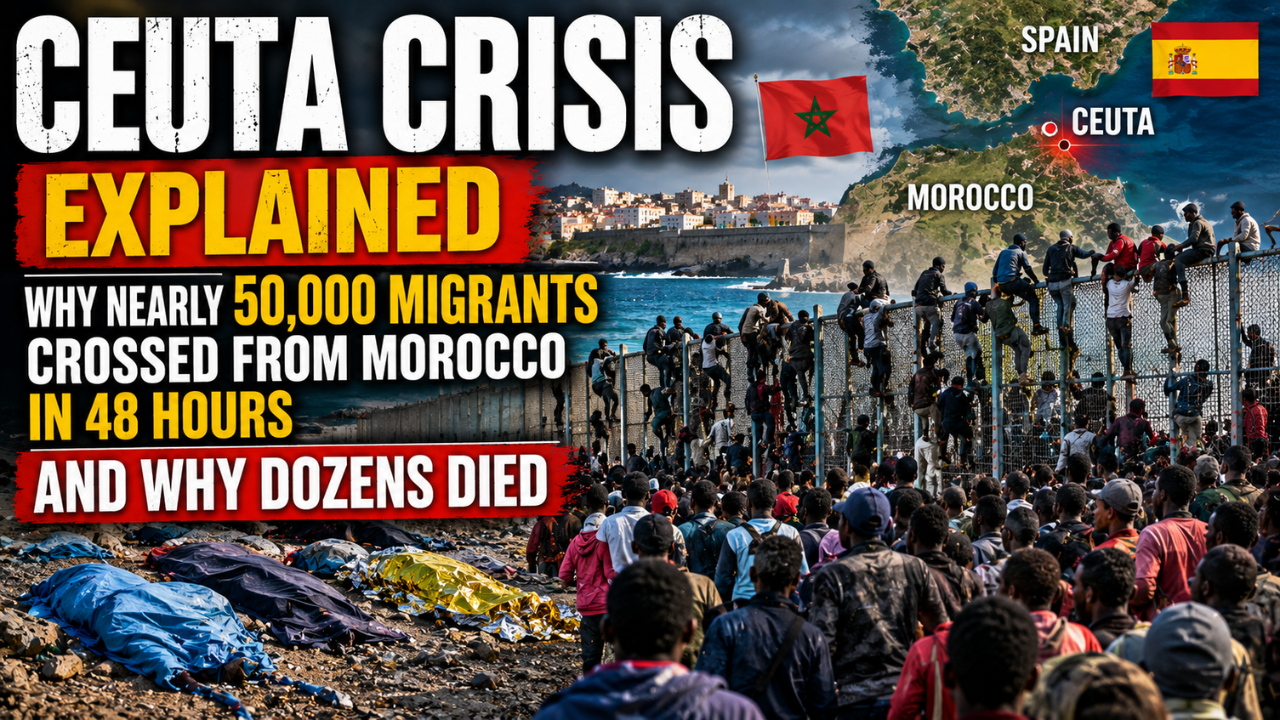
In the span of two days, a Spanish territory of roughly 85,000 people saw close to 50,000 migrants cross its border from Morocco. At least 67 people died trying. It’s one of the largest and deadliest single migration events at Europe’s borders in years, and it happened almost overnight, in a five-square-mile enclave most people outside Spain have never heard of.
What is happening?
A massive, sudden surge of migrants crossed from Morocco into Ceuta, a small Spanish territory on the North African coast, beginning Thursday, July 30, 2026. According to TIME’s explainer, Spain’s Interior Ministry said close to 50,000 migrants had rushed into Ceuta since Thursday morning, though the ministry later reported that more than 48,300 had already returned to Morocco by the end of the day.
The human cost was severe and climbed quickly as the crisis unfolded. Early reporting from NPR and Al Jazeera put the death toll at 18, with many drowning and others killed in a stampede at the breakwater fence at Tarajal beach. As the fuller picture emerged, Wikipedia’s incident timeline, citing Reuters and El País, recorded that toll rising to 57, and ultimately to 67 confirmed deaths, with 43 bodies recovered from Ceuta’s waters alone. Spanish state broadcaster RTVE also aired footage of burned cars on the Moroccan side of the border, evidence of clashes accompanying the crossing.
The scale of what happened becomes clearer through local comparison. According to TIME, regional President Jesus Vivas told Spanish broadcaster Cadena SER that arrivals had overwhelmed the city’s social services and security apparatus in the days leading up to the surge, at a rate of more than 300 people a day even before Thursday’s mass breach. Vivas put the scale in stark perspective: “To give you an idea of the scale, for the rest of Spain, this is equivalent to 2% of Ceuta’s entire population. It’s like a million people entering Spain irregularly.”
Why Ceuta, specifically?
To understand why this crisis erupted here rather than anywhere else along Europe’s borders, it helps to understand what Ceuta actually is. According to Morocco World News, Ceuta sits on a small peninsula bordering the Moroccan city of Fnideq, only about 20 kilometers from Tangier, surrounded by the Mediterranean Sea on three sides and connected to Morocco by a relatively short land border — a geography that offers multiple potential routes for attempted entry, whether by land, sea, or the breakwater fence.
Ceuta and its sister enclave Melilla hold a genuinely unique status: they’re the only land borders between the European Union and the African continent. According to Britannica, Ceuta has been fought over and colonized for over a thousand years — passing through Berber, Phoenician, Roman, Vandal, and Byzantine control before Portugal captured it in 1415, with Spain later gaining control in 1580. That makes Ceuta, remarkably, the older of Spain’s two North African territories by more than 80 years.
This deep history is precisely why the territorial question remains unresolved. According to a Real Instituto Elcano analysis, Morocco has repeatedly used pointedly loaded language to describe the two cities — calling them “garrisons,” “occupied,” “expropriated,” or “usurped,” while Spain insists they are simply Spanish municipalities, formally granted Statute of Autonomy status in 1995, predating the modern Moroccan state entirely. Morocco World News confirmed that since gaining independence in 1956, Rabat has consistently maintained that both Ceuta and Melilla are occupied Moroccan territories and has repeatedly called for dialogue over their future — a claim Spain rejects as having no basis in international law, unlike genuinely recognized territorial disputes such as Gibraltar.
That unresolved dispute matters directly for migration, because it shapes how much control Morocco is willing to exert at the border, and when. This is a pattern that has repeated itself for years: sudden loosening of Moroccan border enforcement, followed by mass crossings, often coinciding with periods of diplomatic tension between Rabat and Madrid.
The pattern this crisis fits
This isn’t Ceuta’s first mass crossing crisis, and the parallels to past episodes are striking. According to GlobalSecurity.org’s record, in May 2021 roughly 8,000 people swam or climbed into Ceuta after Moroccan authorities appeared to loosen border controls for a couple of days — an episode Spain’s then-Prime Minister Pedro Sánchez called “a serious crisis for Spain and Europe” at the time. According to Al Jazeera’s reporting from that period, that 2021 surge came amid a major diplomatic dispute between Spain and Morocco over Madrid’s decision to give medical assistance to Brahim Ghali, a rebel leader from Western Sahara — a disputed territory Morocco annexed in the 1970s that Rabat considers a core national interest.
The pattern goes back further still. A BBC profile of the two enclaves recorded that in June 2022, at least 23 people were killed when about 2,000 migrants attempted to scale the border fence at Melilla — a death toll that, until this week, stood as one of the deadliest single incidents at these borders in recent memory. This week’s toll of 67 has now surpassed even that.
Migrant rights activist Zakaria Zarroqui drew the direct comparison to Al Jazeera this week, noting the scale of this latest surge was similar to the 2021 episode, and warning that “the situation remains out of control as we speak,” with people continuing to flock to the Moroccan border city of Fnideq hoping to cross.
What makes this crisis notable is that it runs directly counter to the broader national trend across the rest of Spain. According to TIME’s reporting on Spain’s Interior Ministry statistics, irregular migrant arrivals across the rest of Spain actually fell from 17,990 in the first six months of 2025 to 12,138 over the same period in 2026. Ceuta specifically, however, saw the opposite trajectory: 2,582 land arrivals compared with 978 during the same period the previous year — an increase of 164 percent, even before this week’s mass surge pushed the numbers dramatically higher still. That divergence suggests something specific to Ceuta’s border situation changed, rather than a broader regional migration trend driving the crisis.
Who is affected and how?
For the migrants themselves, the human stakes were made starkly clear in on-the-ground reporting. According to El País, cited in Wikipedia’s incident record, thousands of migrants who made it into Ceuta were reported begging not to be sent back to Morocco, with the headline capturing their plea directly: “Not Morocco!” That detail underscores that for many crossing, the destination wasn’t just about reaching Spanish or European soil in the abstract — it reflected a specific desire not to be returned to conditions in Morocco itself.
For Ceuta’s government and residents, the crisis prompted an immediate emergency response. TIME reported that regional President Jesus Vivas declared an “absolute humanitarian and social emergency” and called on Madrid to send troops to help reassert control over the territory — a direct echo of the military deployment Spain used to respond to the 2021 crisis. It’s also worth noting that Ceuta already carries significant economic strain that predates this crisis: a BBC profile recorded unemployment among the native workforce running above 30 percent, among the highest rates anywhere in Spain, meaning the territory’s social systems were already stretched before this surge began.
For Spain’s national government, the crisis presents an immediate operational challenge: processing and, in many cases, returning tens of thousands of people in a matter of days. The fact that more than 48,300 of the nearly 50,000 who crossed had already been returned to Morocco by the end of the first day shows the scale of the rapid response effort, even as the situation remained fluid and activists warned it was far from fully resolved.
What happens next?
Whether the crisis fully resolves or reignites. Wikipedia’s tracking of the incident notes that Spain reported the “huge surge across the border into the enclave has reversed, half of migrants go back” — but with Zarroqui warning the situation remained “out of control” as people continued flocking toward the border hoping to cross, whether this settles quickly or continues in waves remains genuinely uncertain.
Diplomatic fallout between Madrid and Rabat. Given the historical pattern of these crises coinciding with periods of Spain-Morocco tension — often tied back to the unresolved territorial status of Ceuta and Melilla themselves, or to disputes like Western Sahara — how each government characterizes responsibility for this crisis will likely shape near-term relations between the two countries.
Spain’s next official migration report. According to NPR, Spain’s Interior Ministry said it would publish its next migration report the following Monday, which should offer a clearer, more complete official accounting of exactly how many people crossed, how many remain in Ceuta, and how many have been returned.
Key takeaway
- Nearly 50,000 migrants crossed from Morocco into the Spanish enclave of Ceuta over roughly 48 hours beginning July 30, 2026, with at least 67 confirmed deaths, many by drowning, surpassing the 23 deaths recorded in a 2022 Melilla crossing that had previously stood as one of the deadliest incidents at these borders
- Ceuta and Melilla remain the only land borders between the EU and Africa, and their unresolved territorial status — claimed by Morocco as “occupied” territory since 1956, but held by Spain since 1580 — has repeatedly coincided with sudden mass crossings whenever Moroccan border enforcement appears to loosen
- The surge directly contradicts the broader trend across Spain, where irregular arrivals have actually fallen nationally in 2026, even as Ceuta specifically saw a 164% increase in land arrivals compared to the same period last year, well before this week’s crisis began