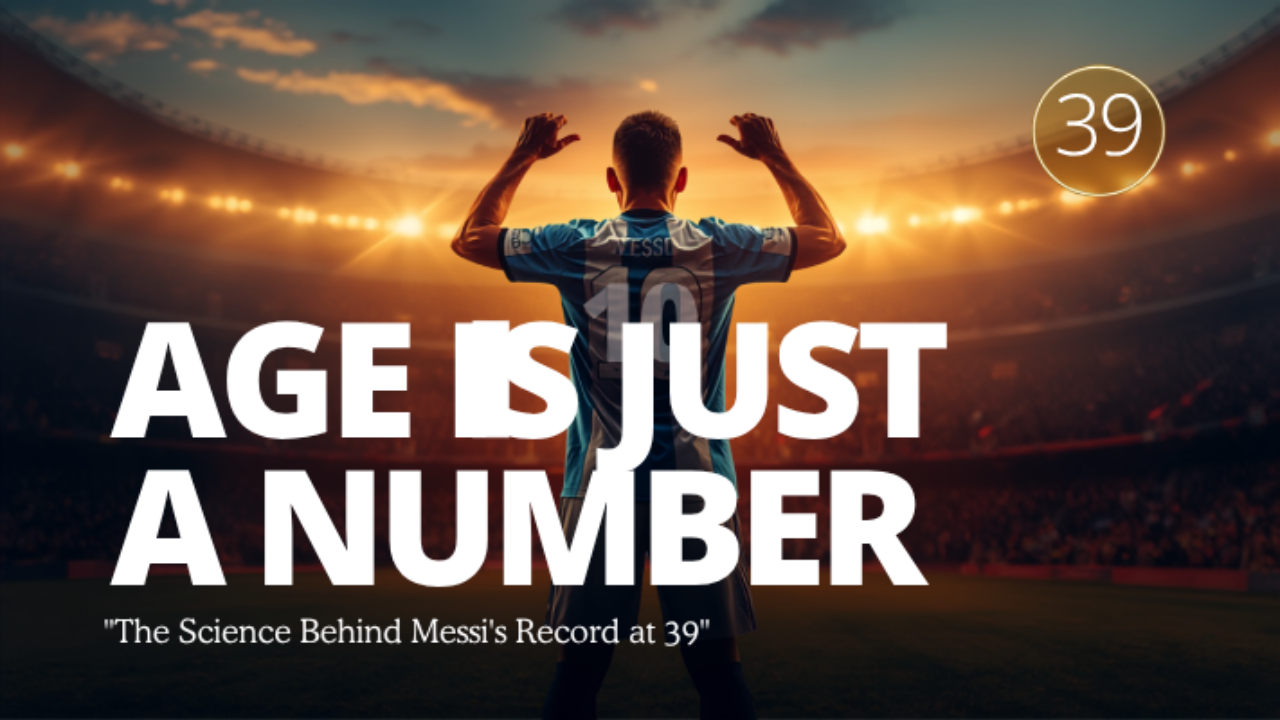
Most professional footballers retire by 35. Lionel Messi is 39, playing in his sixth World Cup, and just became the first player in history to score in seven consecutive World Cup matches. This isn’t a story about talent. It’s a story about what he does differently, and the science behind it applies far beyond football.
The record that shouldn’t be possible
According to Al Jazeera, Messi came off the bench in Argentina’s win over Jordan to score his sixth goal of the 2026 tournament, a seventh straight World Cup match with a goal, a record no one else has ever touched. As ESPN documented, he’s now the first player ever to appear in six separate World Cups, and he opened this tournament with his first-ever World Cup hat trick at an age when most elite athletes are commentating from a studio, not playing.
Football careers are famously short. The physical decline that ends most players’ primes in their early thirties is brutal and well-documented. Messi isn’t defying that because he’s a genetic outlier; plenty of equally gifted players faded years earlier. He’s defying it because of what he’s built around his talent, and there’s now real science explaining exactly how that works.
What the research actually says about aging athletes
Messi isn’t alone in this pattern, and researchers have started paying close attention to why. According to sports performance research compiled by Teamo, athletes like Tom Brady, LeBron James, Serena Williams, and Cristiano Ronaldo have collectively rewritten the traditional career arc, maintaining elite performance well into their late 30s and even 40s a trend researchers attribute to advances in sports science, nutrition, and recovery technology rather than genetic exceptions.
The physiology behind this is more specific than “staying fit.” According to a detailed breakdown of athletic longevity research from Aypex Move, the average person loses up to 1% of muscle mass per year after age 30. But athletes who maintain high-intensity training experience significantly lower losses, because continued activation of fast-twitch muscle fibers slows the decline. The same research found that in Olympic weightlifters and sprinters, neuromuscular studies show athletes in their late 30s and early 40s retain roughly 90% of their peak strength compared to a 20-30% decline in untrained individuals over the same period. The mechanism isn’t magic. It’s the continued, deliberate recruitment of motor units that most people simply stop training as they age.
There’s an even deeper layer to this. A study published in Science Advances, using longitudinal data on over 10,000 elite baseball and basketball players, found that the age at which an athlete hits peak performance and the rate at which they subsequently decline actually predicts long-term survival and aging patterns decades after retirement, independent of body mass, height, or era. In other words, how someone manages their physical decline in their prime doesn’t just affect their playing career. It appears to be a marker for how their whole body ages.
Separately, a systematic review published in the Sports Medicine journal analyzing decades of data across baseball, football, soccer, basketball, and cycling found that elite athletes consistently show superior longevity outcomes compared to both the general population and even other athletes. As TecScience reported on a related meta-analysis of 154 scientific articles, competing at an elite level for years is associated with greater life expectancy, and interestingly, the research found no meaningful difference between gold medalists and athletes who merely competed. Simply sustaining high-level competitive activity, not winning, was the variable that mattered.
It’s not talent. It’s the boring stuff, repeated for two decades.
Put together, the science tells a consistent story: elite longevity isn’t about a single genetic gift. It’s about a small number of unglamorous habits, sustained far longer and more consistently than almost anyone else is willing to sustain them.
For Messi, that’s shown up in a career-long, almost obsessive commitment to recovery, conditioning, and body management that’s kept him largely injury-free for two decades at the highest level of physical competition on Earth. It’s shown up in a game built increasingly on efficiency and decision-making rather than raw athleticism the parts of performance that don’t decline the way speed and explosiveness do with age. And based on the neuromuscular research above, it likely reflects continued high-intensity training that has preserved fast-twitch muscle activation most 39-year-olds, athlete or not, have long since let atrophy.
None of that is exciting to read about. None of it goes viral on its own. But it’s the actual mechanism behind a record that “shouldn’t be possible,” and it’s measurable, not mystical.
Why the mental side matters just as much as the physical
The Apexx Move research points to something equally important: psychological adaptation. Athletes who sustain dominance for a decade or more, the research notes, separate themselves through a combination of neuromuscular efficiency, metabolic resilience, and psychological adaptation the ability to keep finding motivation and focus long after the novelty, prize money, or external validation that drove them in their twenties has been fully achieved.
This is the part that’s genuinely hardest to replicate, and it’s the part most “longevity” advice skips entirely. It’s relatively straightforward to describe a training regimen. It’s much harder to explain how someone stays motivated to execute that regimen, at the same intensity, for twenty consecutive years, well past the point where they’ve already won everything there is to win. Messi has nothing left to prove statistically. He’s still playing; he does.
The lesson that has nothing to do with football
Strip away the sport, and the pattern is the same one behind almost every case of extraordinary longevity in any competitive field: people who last decades longer than their peers usually aren’t the most naturally gifted people in the room. They’re the ones who figured out, early, which parts of their performance would decline with time and which parts wouldn’t and then built their whole approach around the parts that age well.
For Messi, that meant leaning harder into vision, positioning, and decision-making as his raw speed inevitably declined, replacing what time was taking away with something time couldn’t touch. For anyone in any career, the equivalent question is worth asking directly: which of your current strengths are borrowed from youth, energy, or circumstance, and which ones are skills you’re actually building for the long run? A salesperson relying purely on charisma will eventually hit the same wall a sprinter relying purely on speed does. A salesperson who’s spent a decade building judgment, relationships, and pattern recognition has built something that compounds instead of decays.
The research on elite athletes backs this up in a way that goes beyond metaphor. The people who sustain excellence longest aren’t just working harder in a generic sense; they’re specifically and deliberately protecting the systems that decline fastest with age, while doubling down on the ones that improve with experience.
Key takeaway
- Messi is the first player in World Cup history to score in seven straight matches, at 39, in his sixth World Cup, and research shows athletes like him retain up to 90% of peak strength into their late 30s and 40s through deliberate, sustained high-intensity training, compared to a 20-30% decline in untrained people over the same period.
- A Science Advances study of over 10,000 elite athletes found that how someone manages physical decline in their prime predicts long-term aging patterns decades later. Sustained effort in your peak years appears to compound well beyond your career.
- The transferable lesson: identify which of your current strengths will fade with time on their own, and deliberately build the ones like judgment, efficiency, and decision-making that only get stronger with years