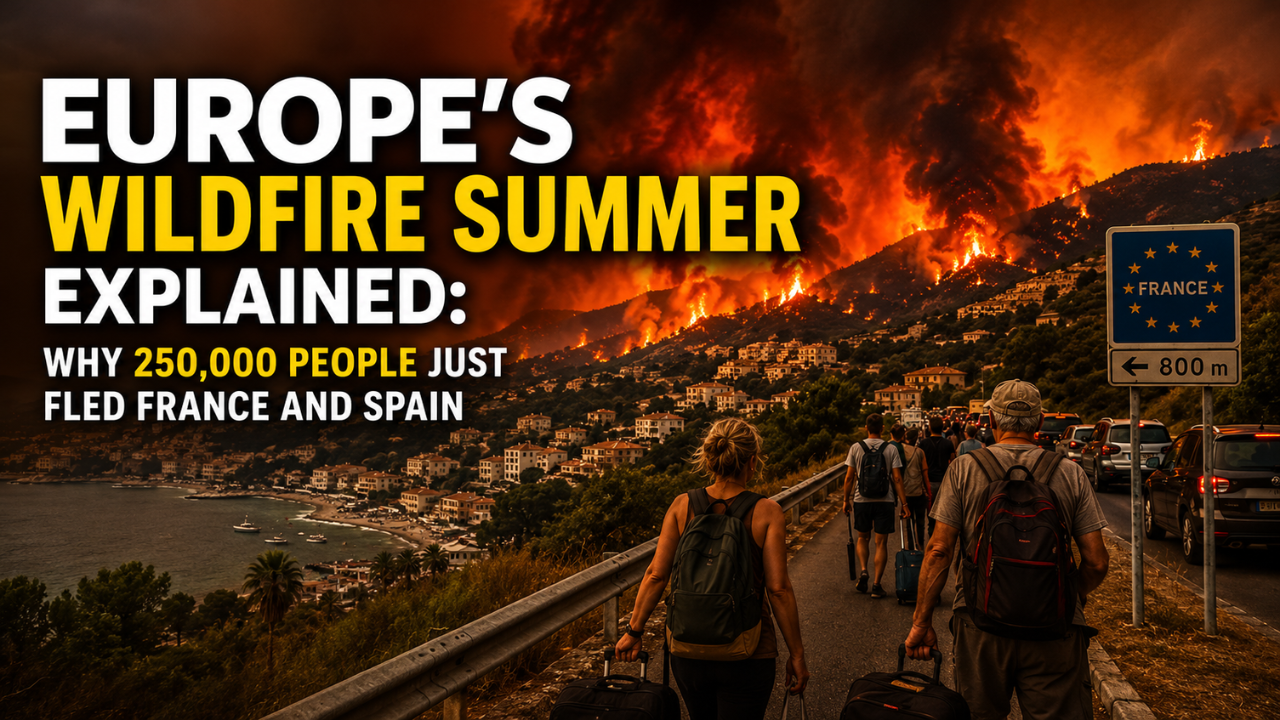
Europe is having its third heatwave in six weeks, and the toll is now measured in tens of thousands of deaths and a quarter-million evacuations. This isn’t an unusual summer. It’s becoming the new normal, and 2026 is showing exactly what that looks like.
What is happening?
Wildfires are tearing through France and Spain right now, forcing mass evacuations across both countries. According to CNN’s live coverage, over 250,000 people have been evacuated across France and Spain as of July 25, with two major fires burning close together along a 14-15 kilometer stretch near San Martín de Valdeiglesias, a town between Madrid and Ávila. The Spanish government has deployed 2,737 personnel, 426 ground vehicles, and 21 aircraft, joined by reinforcement crews from Greece, Italy, and Portugal.
The fires have already turned deadly. The same CNN report noted a wildfire in the Spanish town of Manises killed one person, and French authorities issued emergency phone alerts overnight ordering residents in at least five towns in the Gironde department to evacuate toward Bordeaux, with thousands now sheltering there as the flames close in on one of France’s most famous wine-producing regions.
This is not an isolated event — it’s the third wave. According to the World Socialist Web Site’s report, this marks Europe’s third heatwave in six weeks, and a separate blaze in southern Spain trapped 13 people, with another 10 unaccounted for, burning through more than 55,000 hectares — roughly double the average for this time of year over the past two decades. Al Jazeera reported that a separate fire in Spain’s Guadalajara region has burned 32,000 hectares, making it one of the country’s largest recorded blazes.
Why did this happen?
The wildfires are a direct consequence of an extraordinarily severe and repeated heatwave pattern gripping the continent since June. According to Inside Climate News, the fires followed a record-breaking June heatwave that caused thousands of deaths, strained healthcare systems, dried out vast amounts of land, and was followed by continued triple-digit temperatures across southern Europe.
The mortality data from that June heatwave alone is staggering. According to the World Socialist Web Site, the European mortality monitoring service EuroMOMO estimates roughly 10,600 people have been killed by the heat so far, including over 5,000 in Germany, more than 2,700 in Britain, and over 2,000 in France. A separate Politico analysis cited in the same report identified 14,000 excess deaths across just six countries from the June heatwave alone. Al Jazeera separately reported that France recorded 5,764 more deaths than usual between June 17 and July 2 — a period authorities described as showing “unprecedented” excess mortality among people aged 15 and older.
Dry vegetation left behind by the repeated heat is now fueling the fires directly. With back-to-back heatwaves draining moisture from soil and forests across the Mediterranean, France, Spain, Portugal, Italy, and Greece have all faced elevated wildfire risk simultaneously — a pattern that has become increasingly common as summers in the region grow hotter and drier.
Who is affected and how?
The human toll extends well beyond the immediate fire zones. In France, according to CNN, a wildfire near Lacanau in the Gironde region — amid worsening drought conditions — has forced new evacuation orders, while smoke from a separate blaze near the Arcachon basin in southwestern France has spread across the region. Emergency responders have paid the highest price in some cases: the World Socialist Web Site reported that a 22-year-old firefighter lost his life battling a fire in the French Alps.
The economic and cultural impact is also significant, particularly for France’s wine industry. CNN reported that as wildfires burn west of Bordeaux — one of the world’s most famous wine-producing regions — concerned wine collectors and enthusiasts around the world have been reaching out to industry experts to ask about the fate of the 2026 vintage.
There’s also a stark economic contrast running underneath this crisis. The World Socialist Web Site’s report noted that six of Europe’s leading oil companies made $21.7 billion in profits in the first quarter of 2026 alone — 43% higher than the same period the previous year — largely attributed to the war in Iran driving up energy prices. The same companies have made $252 billion in profits since the last time quarterly earnings were this high, which coincided with the outbreak of the Ukraine war in 2022. That juxtaposition — record heat deaths and record fossil fuel profits occurring simultaneously — has become a recurring point of criticism from climate advocates.
Countries beyond France and Spain are also affected. Al Jazeera reported that extreme weather has sparked warnings and restrictions in Italy, Greece, and Cyprus as well, with several fires burning across Sicily prompting scattered evacuations.
What happens next?
More heatwaves are likely before summer ends. With this already the third heatwave in six weeks and continued high-risk conditions across the Mediterranean, meteorologists and emergency services are bracing for additional waves of extreme heat and fire risk through August.
International firefighting cooperation will likely continue. With Greek, Italian, and Portuguese crews already reinforcing Spanish firefighting efforts, the scale of these simultaneous fires may require even broader European mutual aid arrangements as the season continues.
Long-term questions about climate adaptation will intensify. With excess mortality figures from repeated heatwaves now running into the tens of thousands and wildfire damage regularly exceeding historical averages, pressure is likely to grow on European governments to invest more heavily in heat-health warning systems, air conditioning infrastructure, and wildfire prevention — even as fossil fuel companies continue reporting record profits from the broader energy market disruptions of 2026.
Key takeaway
- Wildfires have forced more than 250,000 evacuations across France and Spain as of July 25, 2026, marking the third major heatwave-driven crisis in Europe in just six weeks.
- The June 2026 heatwave alone is estimated to have caused around 10,600 to 14,000 excess deaths across Europe, with Germany, Britain, and France hit hardest.t
- The crisis is unfolding alongside record profits for European oil companies, which earned $21.7 billion in Q1 2026 alone, driven largely by energy price disruptions from the Iran war